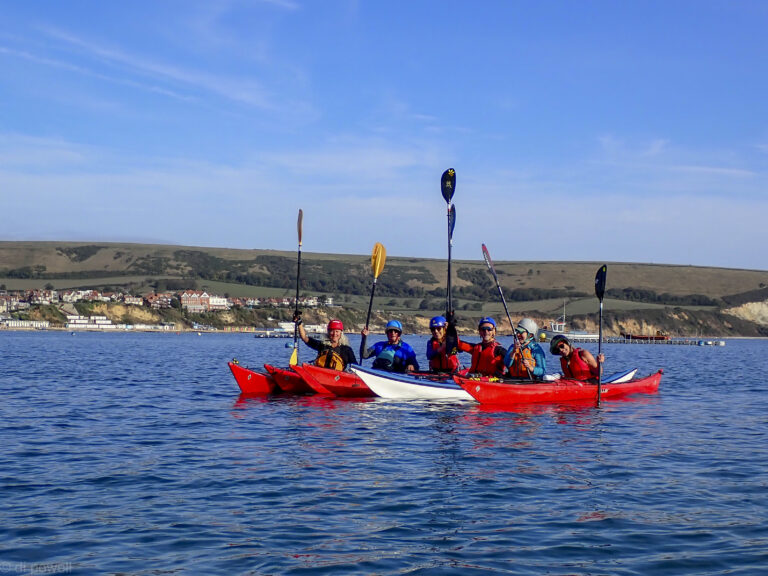
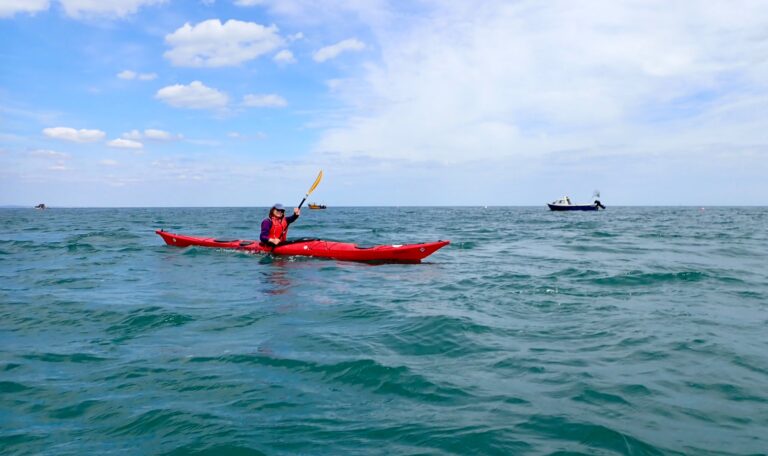
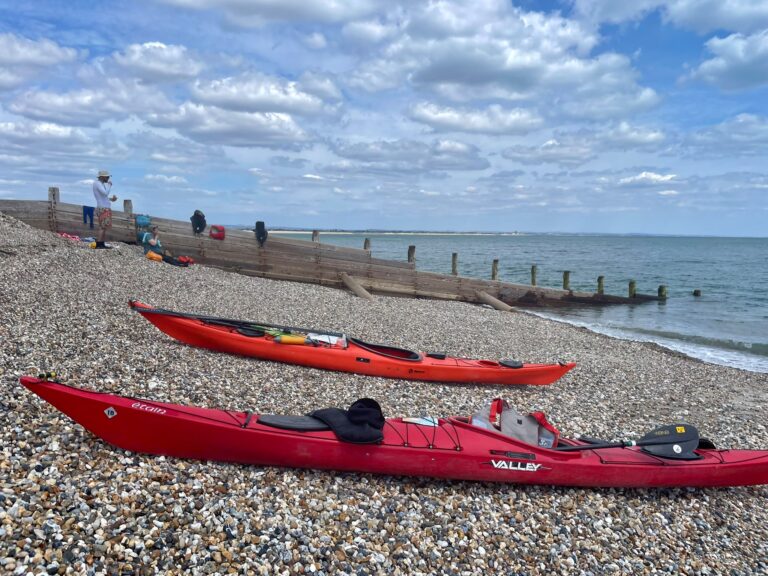
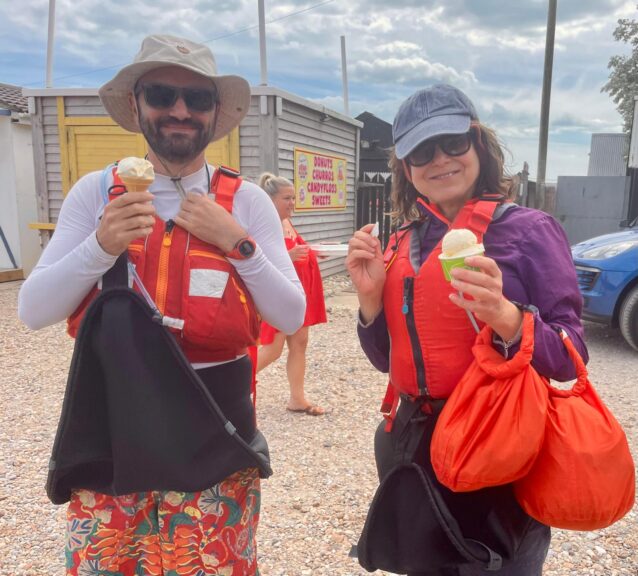
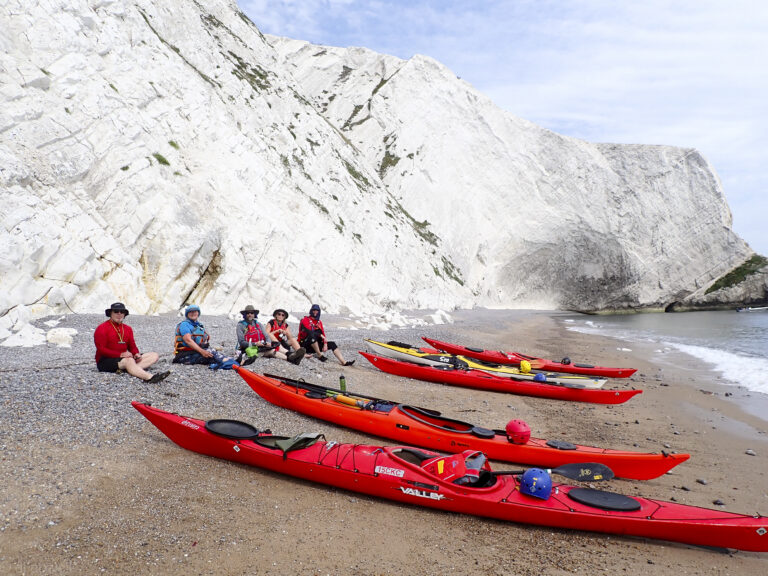
It was time for one of our favourite trips of the year, along the Jurassic Coast. Despite most of our group arriving late on Friday night, we were up early for the start at Swanage. It was a bit of a surprise to get out of our tents in the morning to find the temperature was only 5C after all the warm weather we had been having. Although cold, the skies were clear and very light winds forecast (F2) with virtually no swell.
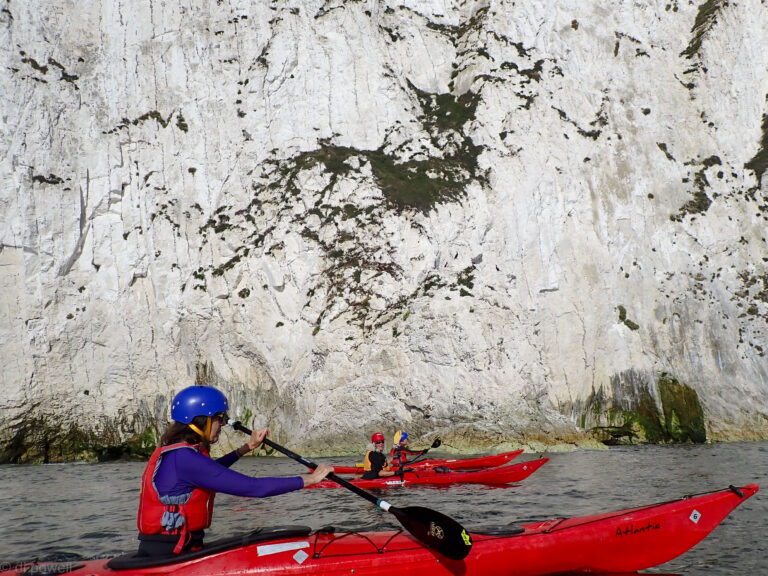
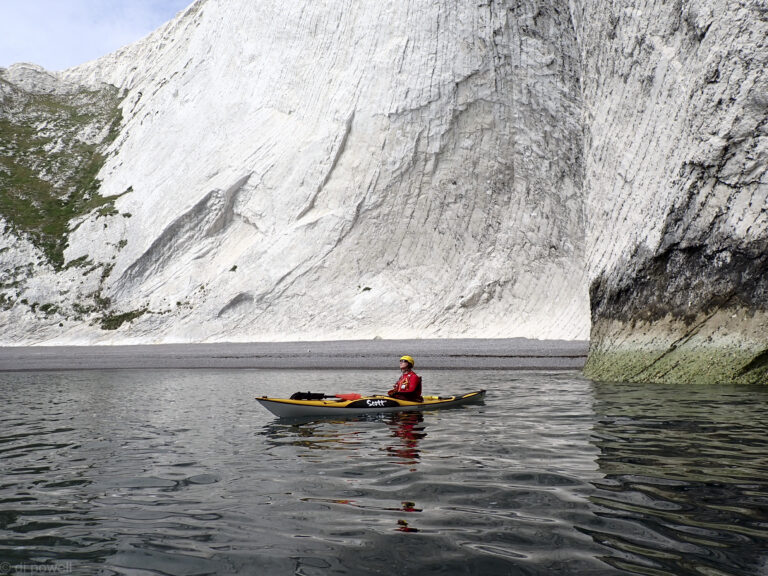
75m white cliffs near Ballard Point
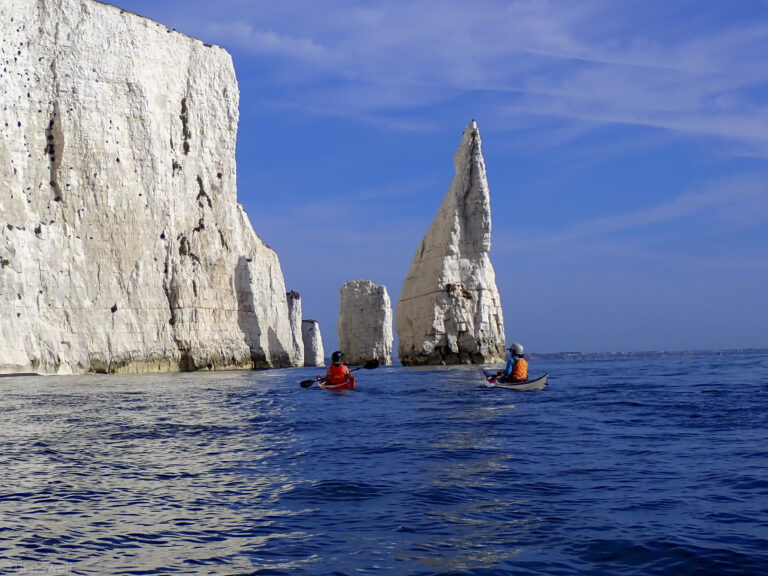
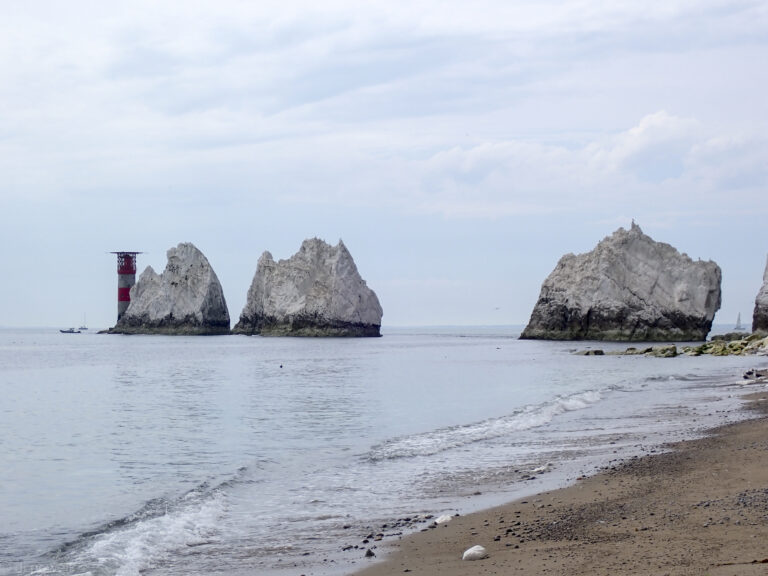
Paddling out from Swanage to Ballard’s Point we could see the white cliffs and stacks knowns as the Pinnacle and Little Pinnacle – always an amazing sight.
The Pinnacle and Little Pinnacle
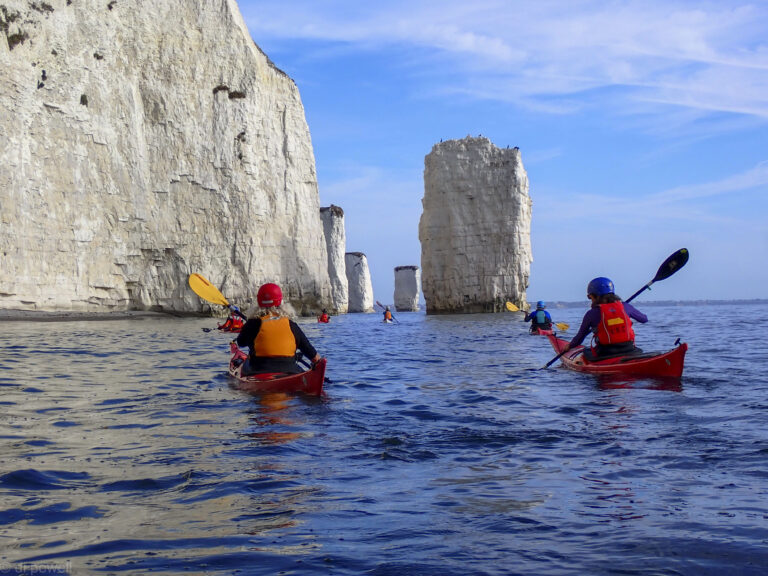
Even more stacks
Passing through the arches at Handfast Point we arrived in Studland Bay, completely protect from any wind. We paddled to the beach for a short break before returning to Old Harry before the tidal stream became too strong.
Passing through the gap at the end of Handfast Point and Old Harry we had a capsize and the paddler lost their paddle. Luckily the wind was so light that a passing sailor was able to collect it and return it to us. Slightly more wind and we may have never seen the paddle again. A timely reminder to hold on to your paddle (and boat) during a capsize.
Disaster averted
After visiting a few more arches and caverns we stopped for a break at New Swanage and then practiced self and assisted rescues before heading back to the launch point.
The cavern of Parson’s Barn
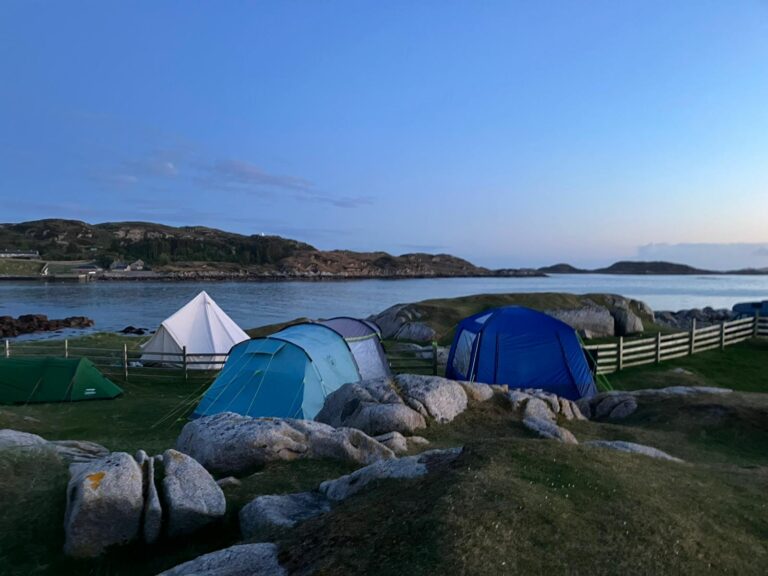
Back at the campsite we had steam trains and (later) owls. The next morning we were once again up early to pack away before paddling. the wind had significantly increased overnight (F4, gusting F5) and we decided that a circumnavigation of Brownsea Island was our best plan as it was a more protected route. On teh outward trip we had wind against tide crossing the channel to Brownsea Island, making conditions interesting. While on the North side of Brownsea there was no wind or conditions. For the first time we were able to explore the lagoon on the North Eastern corner. From Goathorn, we paddled entirely along the edge of Brand’s Bay to keep out of most of the wind. Once we turned to the North East we got a huge push from behind by the wind. That meant we were just in time to have lunch on the beach before packing the kit and boats and heading back to London. Once again a very enjoyable weekend of camping and paddling!
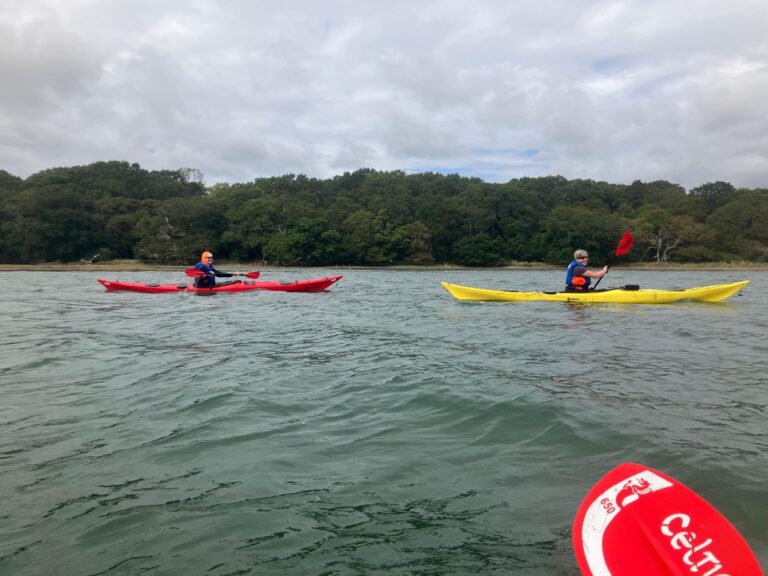
A day paddle in the relatively sheltered waters of Chichester harbour was an ideal way to test out a trip the club can offer to members looking to build their experience on the sea. It is also a trip which can be reached by train/bus with local kayak hire available. This opens it up when we don’t have enough cars with roofracks to transport all the boats a group needs from the Arches.
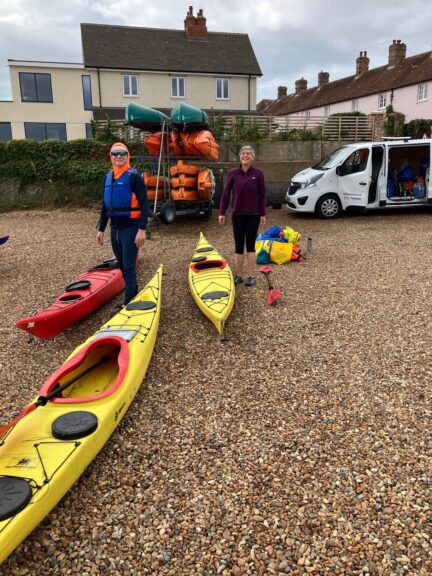
So, Fiona, Mike and I set off from sunny South London on Saturday morning and headed for West Itchenor. We went straight to Fluid Adventures’ base on the beach, where we got set up with our pre-booked kayaks. There was good parking close by and toilets at the Harbour Office where we could change.
Fluid Adventures’ set up on the beach at West Ichenor
Fluid Adventures’ set up on the beach at West Ichenor
Chichester Harbour turned out to be an excellent choice as there was a brisk Southwesterly wind (Force 4 gusting 5) which could have made conditions in the open sea tricky to deal with. We launched from the shingle beach and headed up the easterly arm of the estuary towards Fishbourne.
Our first challenge was to navigate our way through the many boats moored in the harbour. We continued up the channel seeking shelter from the wind at its edges, which also helped us avoid the many dinghies taking part in Saturday races and the ‘foilers’ enjoying the windy conditions. It felt really fun to be part of such a lively water sports community.
Heading up to Fishbourne
Once we got into the quieter part of the channel we caught sight of more wildlife including cormorants, white egrets and a buzzard. We also had a good nosy at the impressive houses coming down to the water’s edge, one with its own sculpture garden !
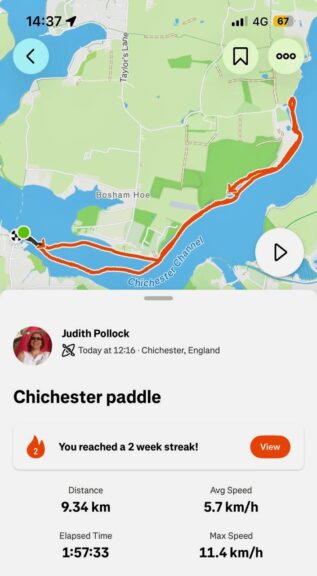
We stopped for a snack as the tide was turning, nosing our boats onto a grassy bank out of the wind. Heading back was a bit of a tougher paddle, but still really enjoyable. We had a little help from the tide but the wind was definitely stronger, so we had to put our heads down and brace into it for a few stretches. We crossed the channel at Longmore Point and as we headed back on the southern side of the channel to West Itchenor the wind was pushing us to the right and the current pushing us forwards, requiring careful positioning so as not to be pushed onto lines of moored boats.
The route of our journey
We were welcomed back by the Fluid Adventures team after safely navigating all the boats and obstacles in the harbour. That left us time for lunch and an ice cream before heading home!
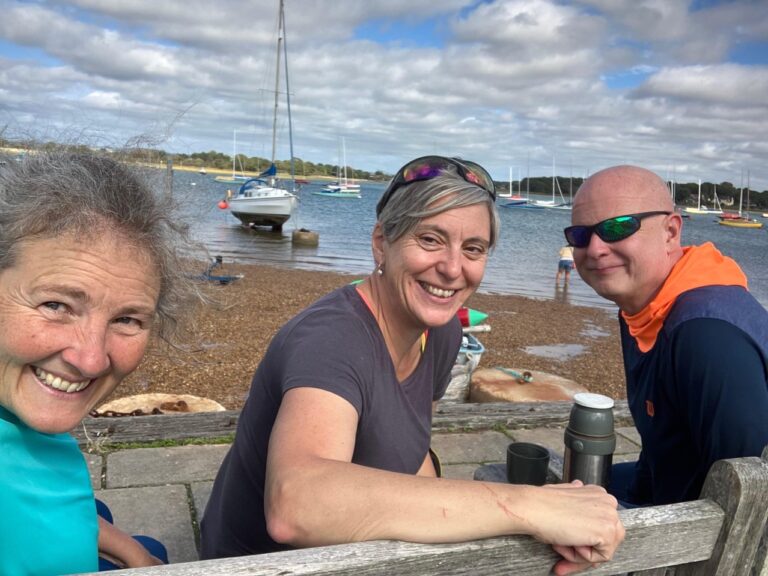
Out of the Wind!
The recce was so successful that Fiona is planning another trip on 11th Oct. See our Sea Trips page for details.
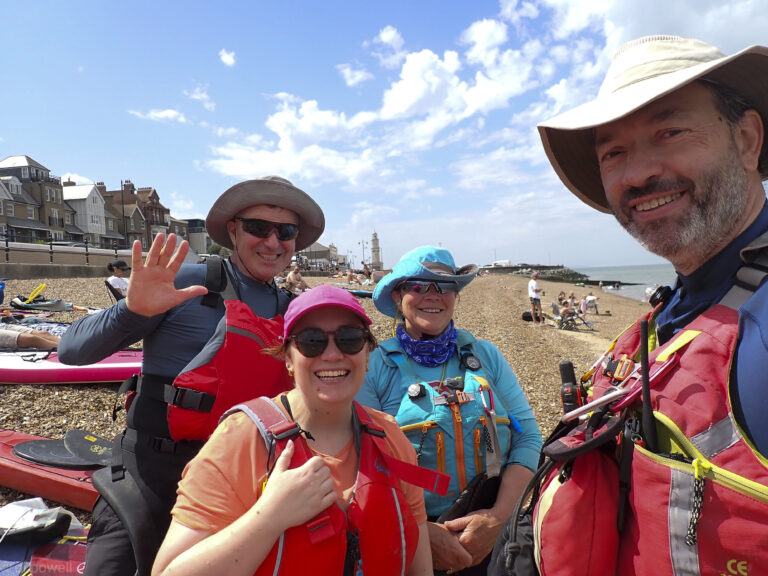
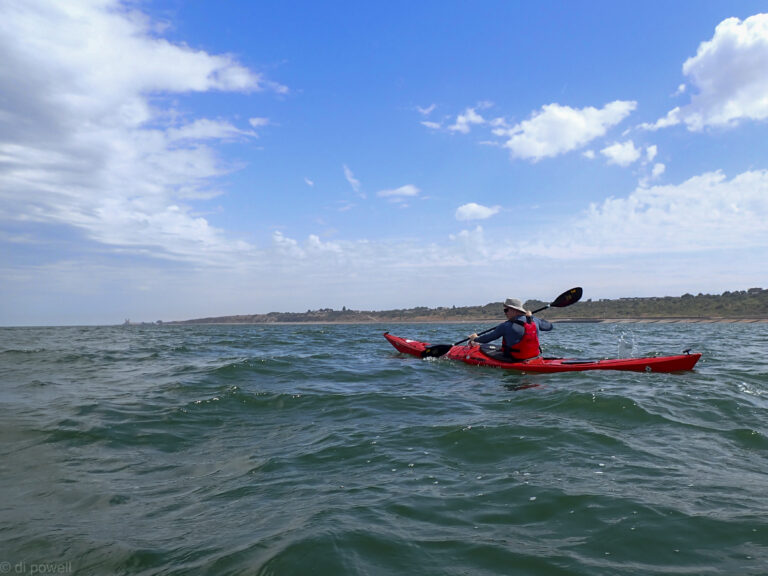
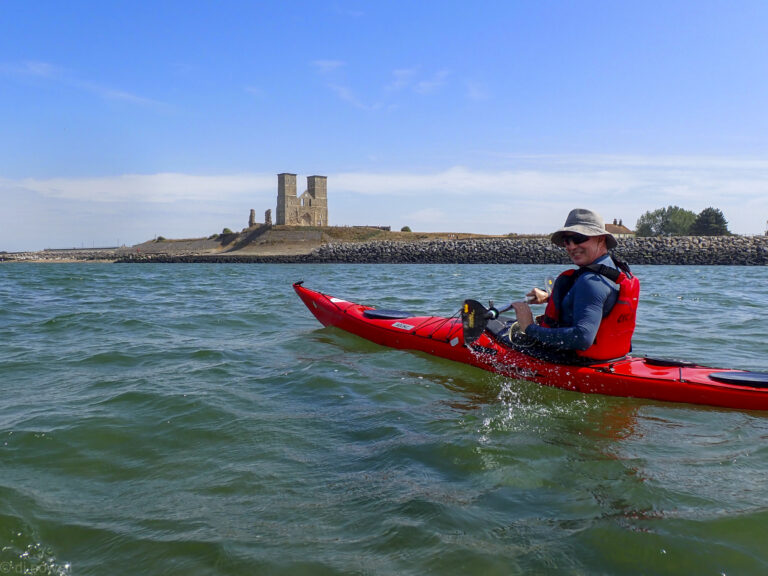
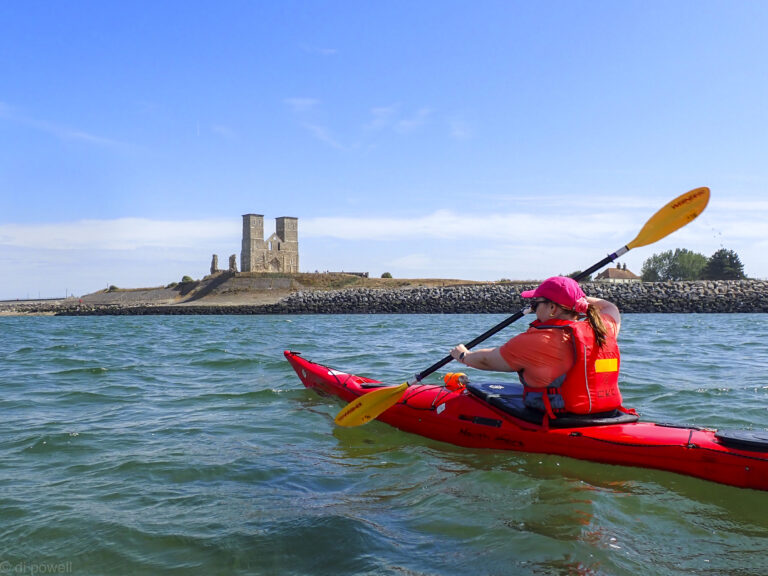
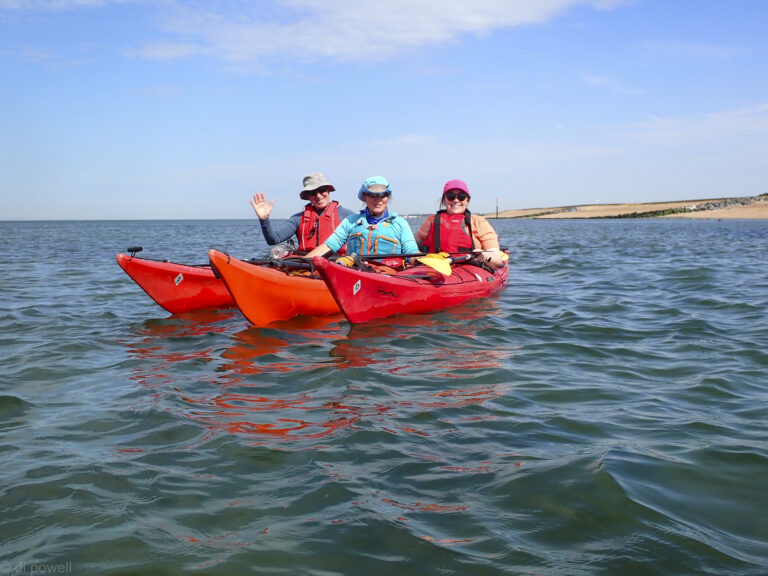
With the sunny weather, Herne Bay was packed full of holiday makers and we felt very over dressed launching from Neptune Bay amongst the sunbathers on a Sunday in mid August. A small group of us had decided to paddle to the old Roman Fort at Reculver. A relatively short paddle, but one that turned out not to be quite as easy as it looked.
North Kent coast
While getting ready there was hardly any wind and the sunshine made it quite hot. As soon as we were on the water, we could definitely feel the F4 gusts in our faces. Wind against tide meant the waves got bigger and we had a fun and bouncy journey to Reculver.
Reculver here we come
Wind and waves dropped as we approached Reculver
Approaching Reculver the wind dropped to almost nothing and as the we were approaching slack, the waves diminished to nothing too. After some lunch on the beach, we started on our return journey. Somewhat inconveniently the wind had changed direction (as forecasted) to be once again in our faces and against the incoming tide. So it was more bouncy waves and focused paddling to get us back to the launch point.
Getting ready for the return journey
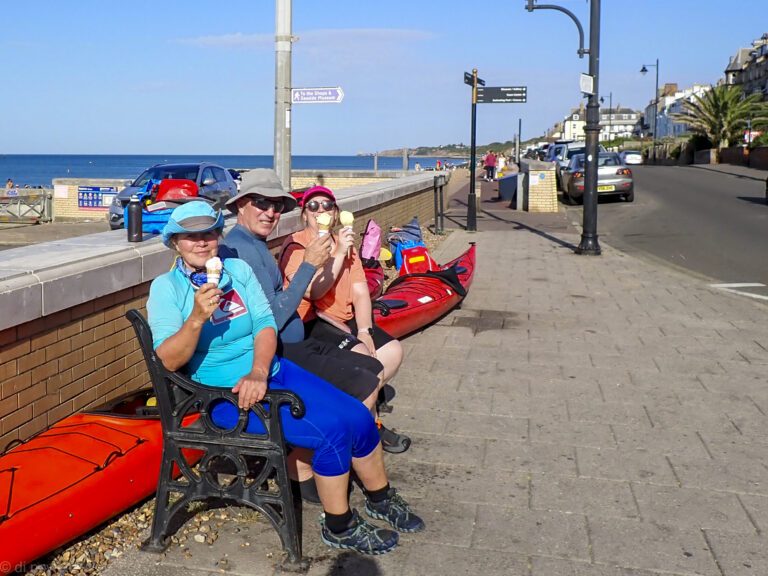
Once back we needed a reviving ice cream before we were ready to put the boats on the cars and head back to the Arches.
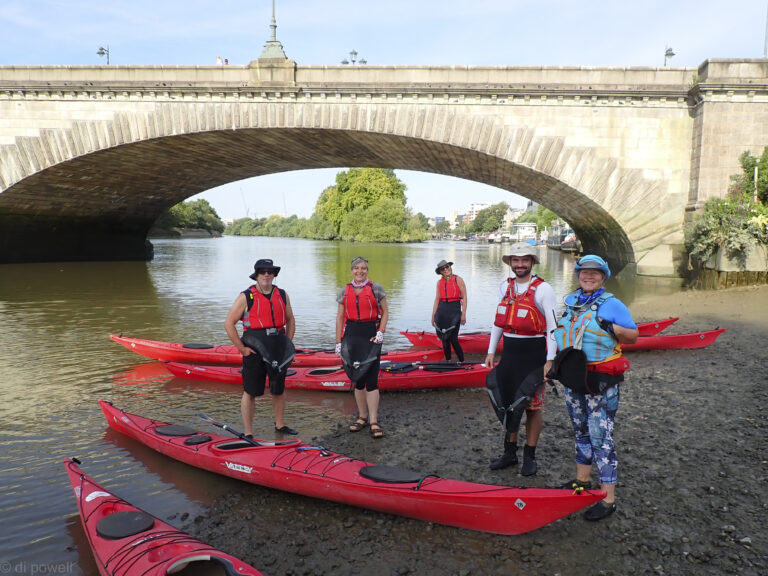
An early morning start from Kew Bridge for our club trip to the Southbank, via Battersea Reach, and back.
A familiar starting point
As we were with the outgoing tide, we were pretty quickly down to Battersea Reach. After a short snack break we were off into central London. Traffic was surprisingly light early on the Sunday morning and for a lot of the trip we had the river to ourselves.
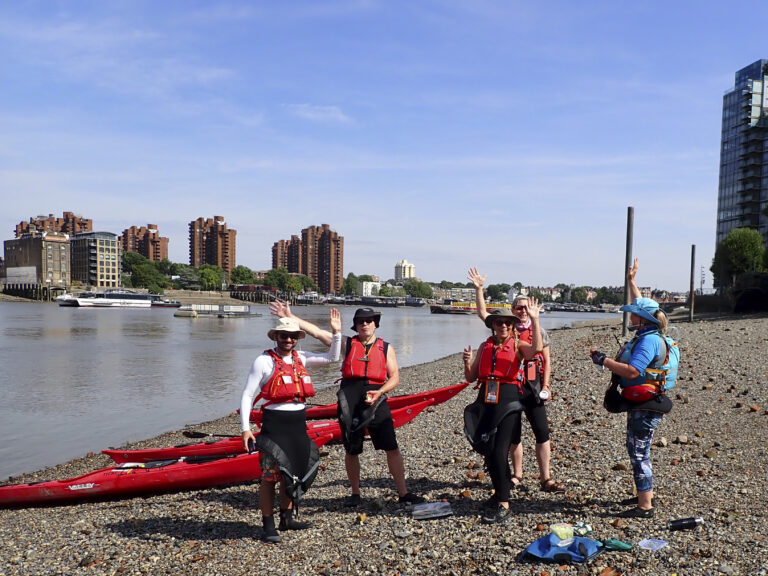
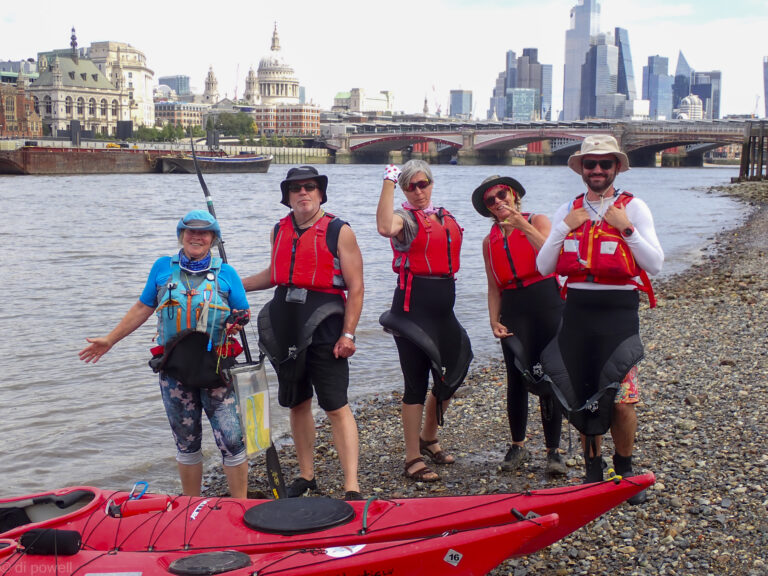
Same characters, different beach
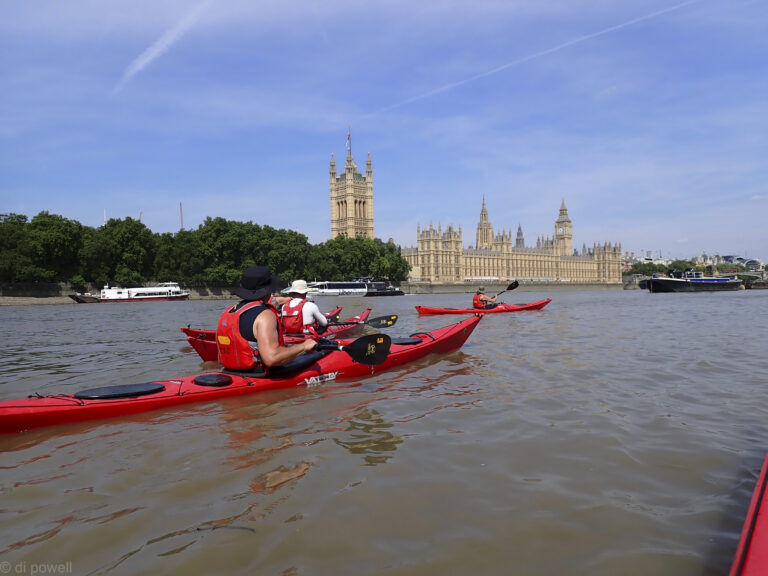
Pretty soon we were seeing familiar landmarks, such as the pagoda at Battersea Park and the Houses of Parliament. Big Ben told us it was 11:25am, which meant we had an hour to get to the lunch spot before the tide turned.
Big Ben scaffolding has gone
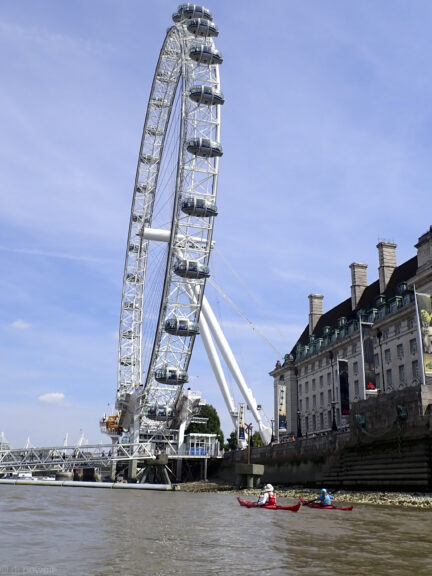
London Eye
We were able to pass directly under the London Eye, much to the amazement of the occupants of the capsules.
We arrived at the beach at Southbank bang on schedule and with an hour for lunch, ordered takeaway pizzas from the gourmet pizza restaurant. We could eat them on the sandy beach, or overlooking the person making a gigantic sand sculpture. Afterwards there was just time for a quick photo opportunity with St Paul’s in the background before starting the return journey. With more traffic and the tide pushing us up river we had to be attentive in crossing and paddling back towards Battersea Reach. A quick stop near to the old Club base at Cremone gave us the opportunity to do some mud larking (a clay pipe, a 1960s specimen bottle and two Bakelite door knobs were found). A long day, both in time and distance (40km), but very enjoyable for a trip we don’t do often enough.
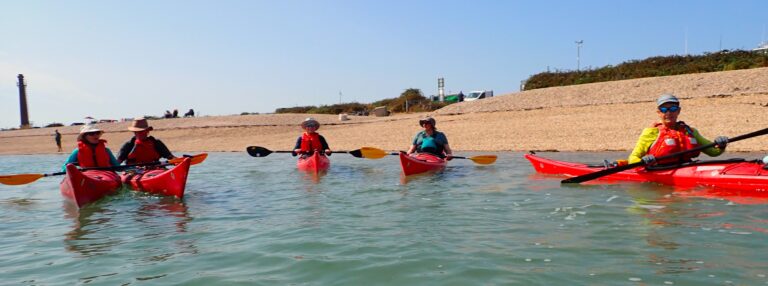
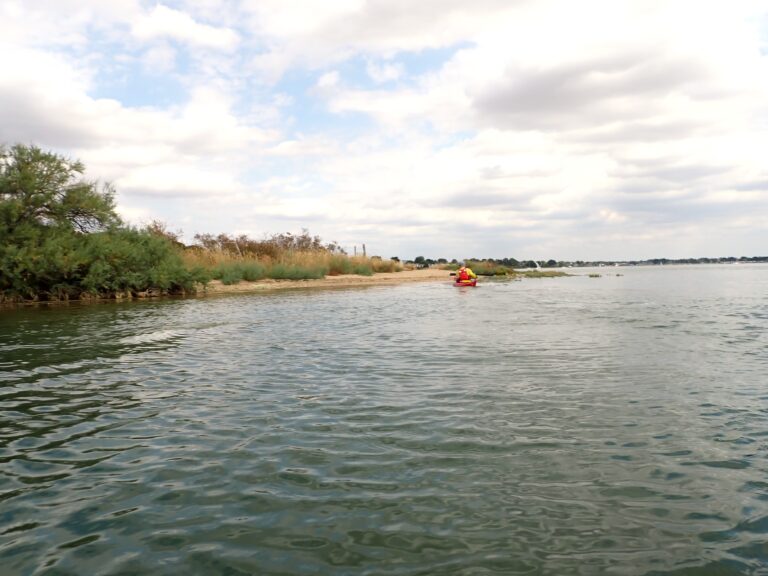
Following a reasonably early Saturday morning start from London, a group of six CKC-er’s in total (with mixed experience of kayaking on the sea) led by Liza, met up by the Southsea Angling Club by Eastney Beach around 10.45am. After off loading the kayaks and associated equipment on the beach, Liza gave the safety briefing along with the planned route for the day. The group then set off in near glorious conditions before midday, catching the incoming tide as we kayaked into Langstone Harbour.
Launch Spot Eastney
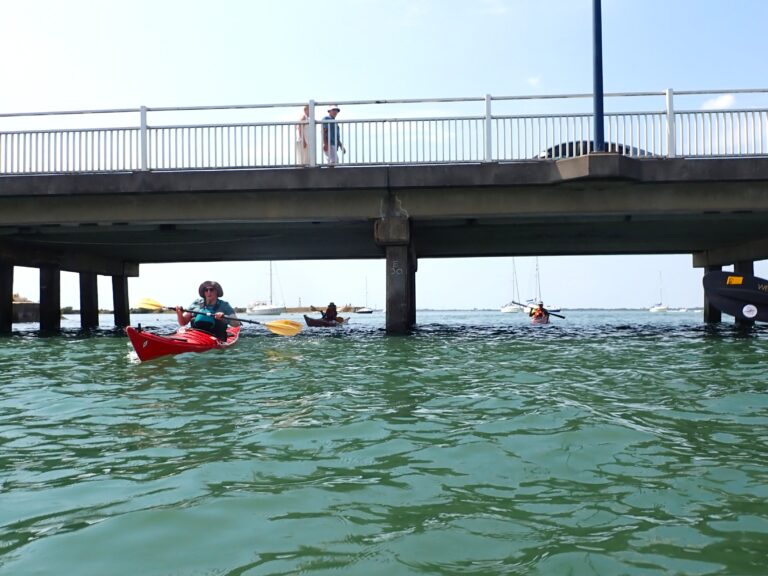
We headed across the harbour, with the first stop being to view the Mulberry Harbour wreck. Locally built on Hayling Island in 1944, it was due for use in the D-Day landings but was abandoned as the structure had cracked during construction. We continued paddling by the coastline of Hayling Island seeing the rich birdlife including various gulls and terns. As it was a high tide, we were able to pass over the disused Langstone (or Hayling) viaduct that carried light engines to and the from the island from the late 1880’s until the 1960’s, before kayaking under Langstone Bridge and entering the Sweare Deep channel.
Navigating under Langstone Bridge
By this point we had been on the water for over a couple of hours and so headed over to Emsworth Harbour to land and have a well-deserved lunch break.
Lunch!
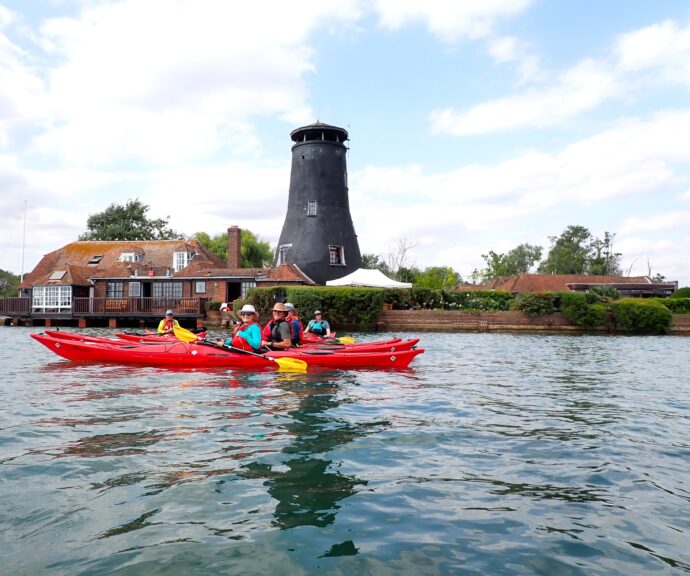
Forty minutes allowed us to thoroughly rest and refuel before paddling along the Havant coastline, stopping by the beautiful and historic Langstone Tide and Watermill complex. Now upscale residences, this complex was constructed in various stages between 1720 through to 1800 using the water power to mill locally harvested cereals and was in operation until the first world war.
Langstone Tide and Watermill complex
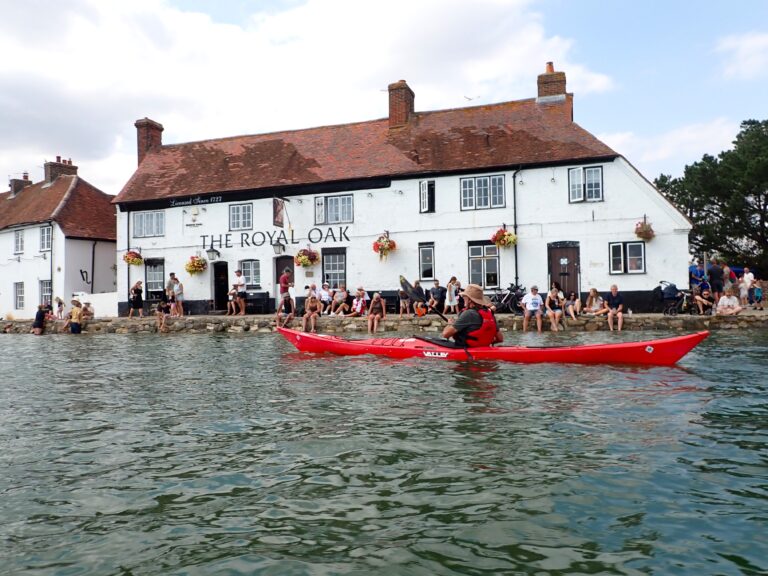
From there, we made the short journey to stop off for a brief comfort break at the Royal Oak public house and passing by the Ship Inn to enjoy some 80’s nostalgia (The Cult’s She Sells Sanctuary was blasting out) before leaving Sweare Deep by the Langstone Bridge and back into Langstone Harbour. We kayaked through the central channel for around 45 minutes back to the entrance of the harbour before landing back at Eastney beach just before five in the afternoon. Changing into dry clothes, loading up the kayaks and other equipment and the debrief meant we all headed off just before 6 in the evening.
Waterside pub
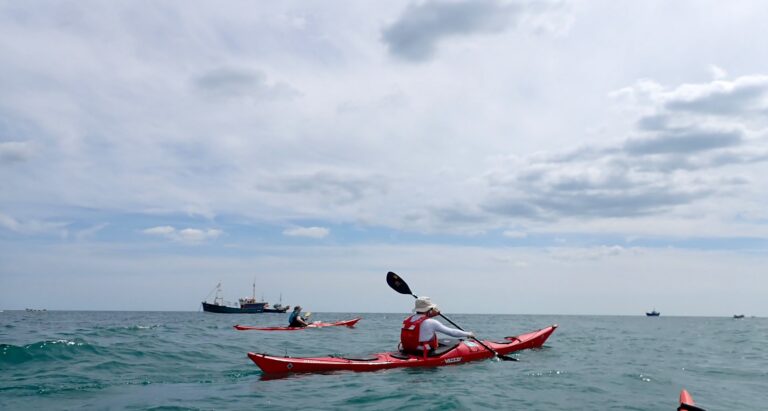
The sea conditions we encountered varied from very placid through to small wind waves; a really good introduction for those of us on our first or second trip on the sea and hopefully an enjoyable work out for the more experienced CKC club members. A big thank you to Liza for planning and leading the trip and also Mary and Safi for sharing with Liza the transporting of the kayaks and other equipment. All in all, a great way to spend a summertime Saturday by the sea.
On Sunday 19 July a small group of four CKC-ers, led by Liza, headed to Bracklesham beach on the south coast, for a lovely paddle on the sea. There’s a car park right by the beach, but on a beautiful sunny weekend day in the summer holidays, it fills up quickly and there were no spaces left at all by the time we arrived just after 10.00. We unloaded the kayaks near “The Beach” café (with adjacent public toilets) and drivers Liza and Mary had to go find parking spaces in the streets nearby.
After a briefing from Liza, and with the tide coming in and a light north/north easterly breeze from behind, we carried the boats down the steep shingle bank and launched in light surf, heading out from the beach to catch the flow. We headed southeast, following the coastline towards Selsey Bill, making good progress. The Windmill at Medberry soon came into view, and the cardinal markings off Selsey Bill became more clearly visible ahead.
Happy days!
As forewarned by Liza, we headed away from the shore and out towards the further cardinal markings as we got closer to Selsey Bill, to avoid the roughest area of water where it suddenly becomes pretty choppy as the current pushes it over the shallow bar. It was indeed rather bouncy with short steep waves coming from various directions, and the bows of the kayaks plunging ahead. It required some extra concentration as we pushed through the turbulence, but it didn’t last long and we were soon in calmer waters again, albeit with the occasional gusts touching force 4.
Around Selsey Bill
We headed close to Pagham beach for lunch, below a row of beach houses, some pretty plush and a few adapted from old railway carriages that had been moved there during WWII to accommodate soldiers ahead of the D-Day landings.
Lunch
After lunch we were back in the kayaks for a short burst to Selsey to get an ice-cream.
Mandatory ice cream stop
Having scoffed those, we were back in the kayaks and did a seal launch, sliding down the shingle in our boats into the water. With the flow still with us, although we found ourselves pushing against occasional gusts of wind. We didn’t need to move out much to navigate Selsey Bill on the way back. It was only mildly choppy and perfectly manageable.
Back in Bracklesham Bay Liza demonstrated a self-rescue, which Emmanuel then tried a couple of times, nail-bitingly close to fully executing it. Fionna then tried and failed, and was rescued mostly ably by Emmanuel.
The fun passed all too quickly, and we headed in, with the 4pm high tide accommodatingly well up the shingle, making landing surprisingly easy. A great day out, excellently planned and led by Liza, with a nice of mix of leisurely paddle, focused concentration around the Bill, and some rescue practice.
Conditions couldn’t have been better for the trip from Hampshire to the Isle of Wight on a Saturday in June. We all assembled at the campsite on Saturday morning to discuss the plan, before heading to the launch point. Most had come down the night before to the campsite amongst trees and were comfortably settled in. This campsite was a much better experience than the previous year, with wild New Forest ponies walking through the campsite while we did our briefing!
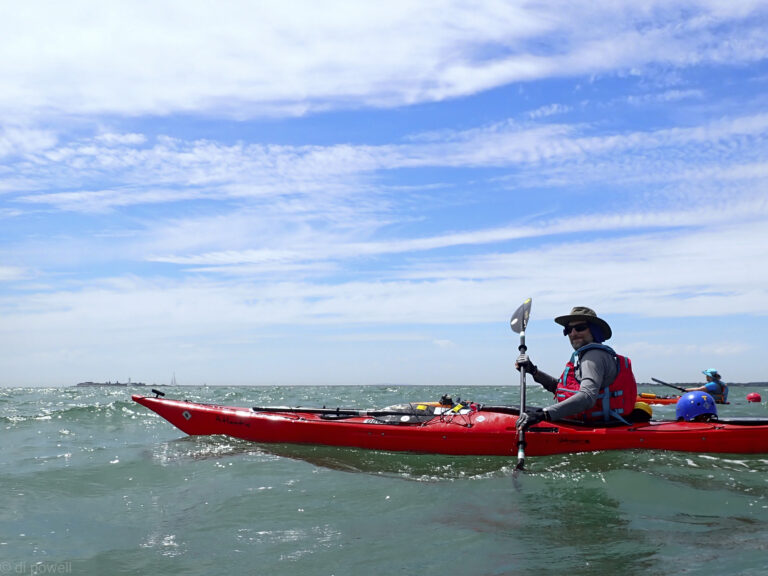
The UK had been experiencing a heatwave and everyone was relieved to get some cooler Solent air for the weekend. It wasn’t long before we launched, heading towards Hurst Castle and Albert Fort.
To the Isle of Wight!
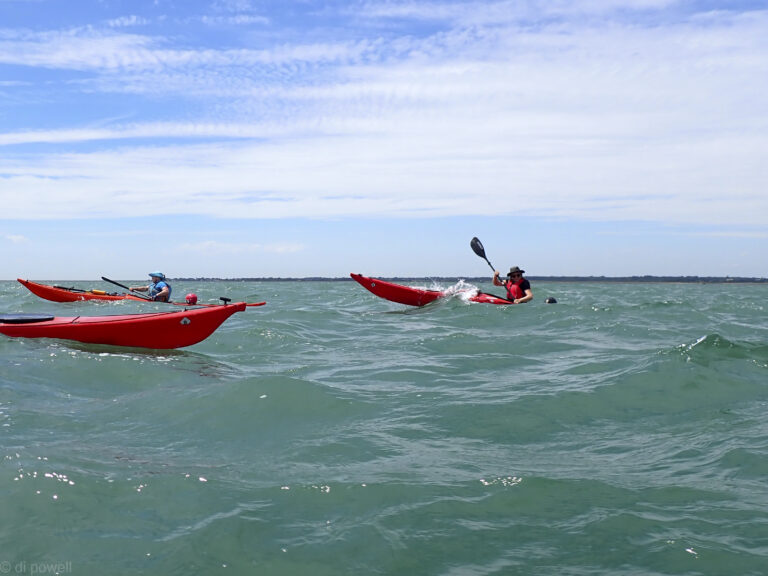
Some waves too
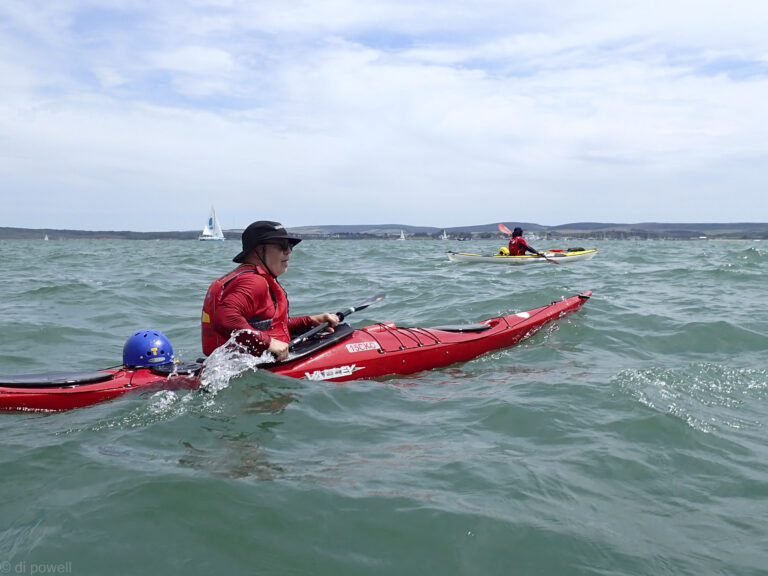
And a lot of yachts
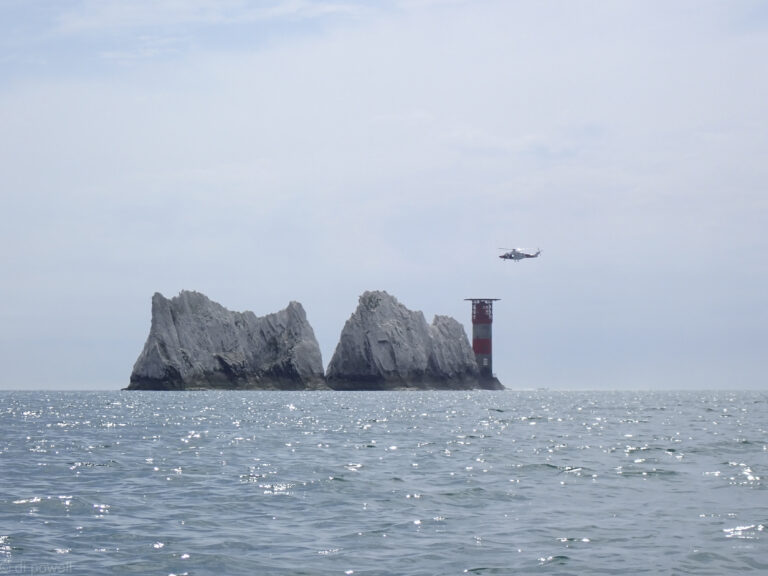
It seemed that every sailor with a boat on the Solent also had the same idea and we had to be alert to the multiple vessels approaching us from different directions until we were well passed Fort Albert. As we approached the Needles an RNLI helicopter overtook us and then hovered for 15 minutes, leaving just as we arrived at the Needles.
RNLI Helicopter
We had no time to speculate what it was doing as we had a tidal gate to meet which meant we landed at Scratchells Bay on the Isle of Wight quickly (accompanied by a seal). After a quick lunch it was back on the water to investigate one of the Isle of Wight caves and impressive cliff face.
Seal for scale
Sun Corner
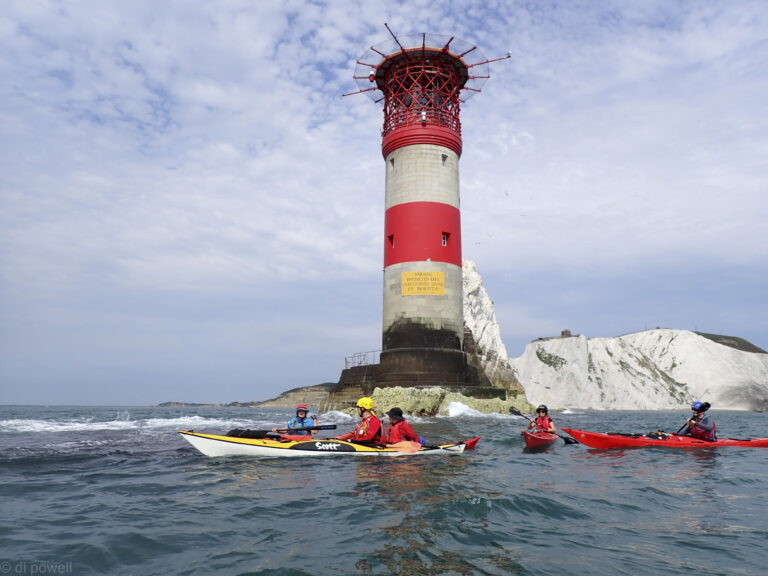
Lighthouse at The Needles
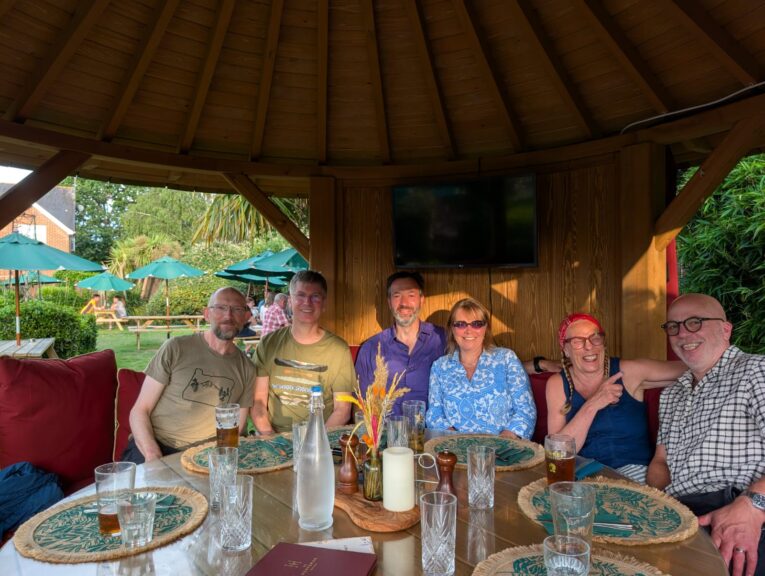
The flow was starting to pick up at the Needles when we rounded the lighthouse, so it was time to head back. There was a lot less traffic on the way back and it seems that Solent sailors don’t stay out after 5pm. A hasty load of the boats, kit and change, then on to the pub at Brockenhurst for dinner, where we had our own private dining pod.
Dinner in the evening sun
Reviewing the day Mike summed up the feeling of the group: the day was dramatic, beautiful and memorable. Here’s to more of these!
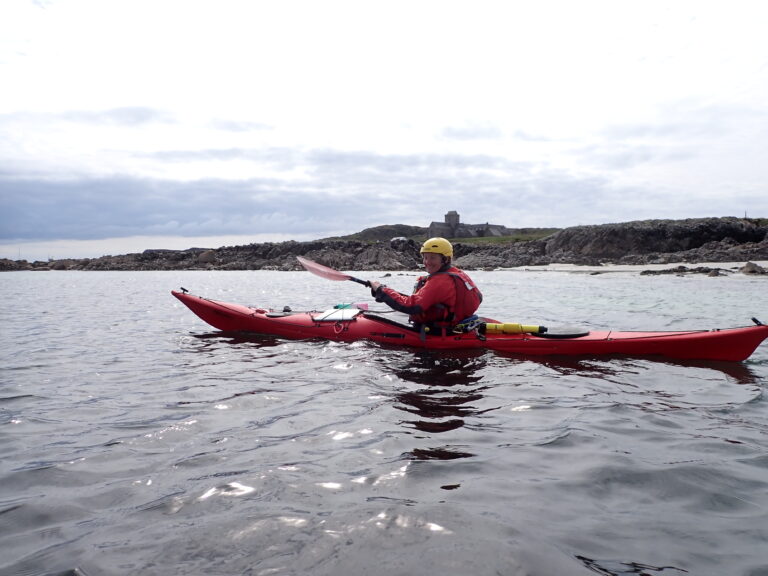
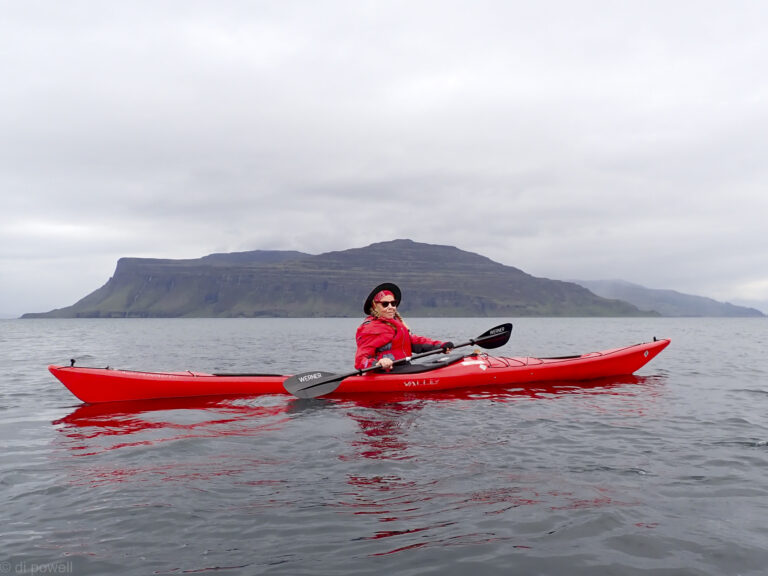
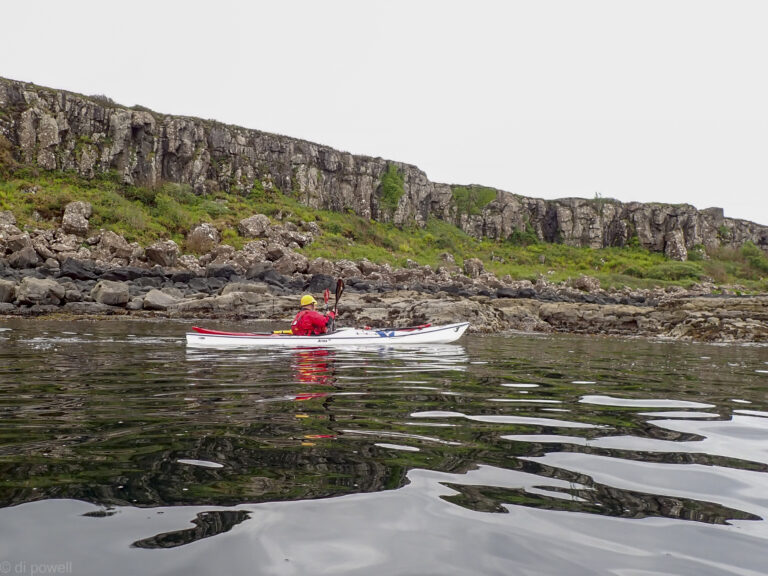
The Isle of Mull is a long way from London and a long way from anywhere. But it wasn’t always that way. Just across the water from the island’s western tip, where CKC pitched camp for a stormy week in May, lies Iona and its abbey, where, if Wikipedia is to be believed, 60 Scottish, Irish, and Norwegian kings lie buried. They and their followers would think nothing about nipping across the Irish Sea or voyaging down the coast past Cornwall to Brittany and beyond. We were beside the original nautical crossroads.
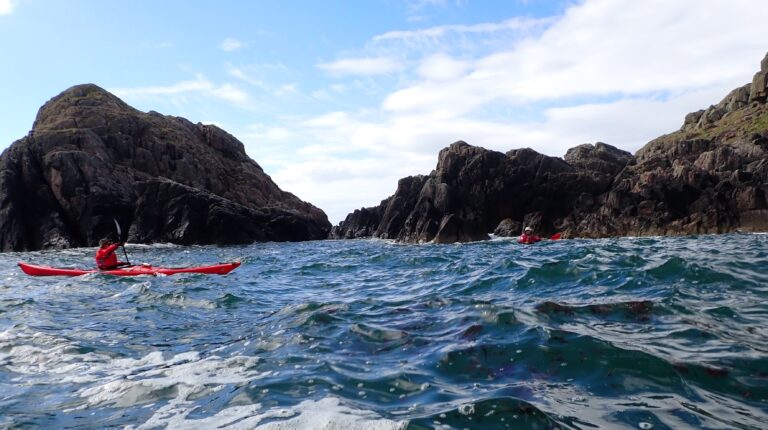
Our trips weren’t quite on the same scale. My day one saw six of us— Fiona, Jude, Gilly, Liza, David, and yours truly— circumnavigating Iona. It was a long day. Liza organised the trip to keep us clear of rock gardens made hazardous by a spring tide running full bore. She also scheduled not one but two lunch breaks on the Atlantic side of Iona so we could ride the flooding tide north.
Dynamic water around Iona
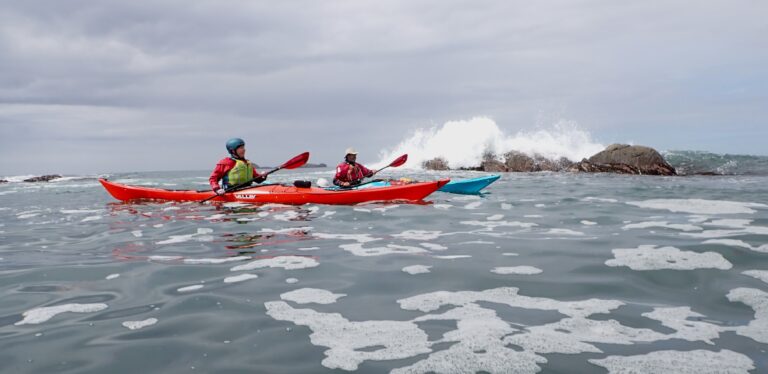
The trip started on the beach at Fidden Farm, our campsite, from where we had a quick hop across the Sound of Iona to the island’s southern tip. There we found ourselves surrounded by white bubbles that stretched in every direction, making the sea resemble an infusion of bath salts.
West side of Iona
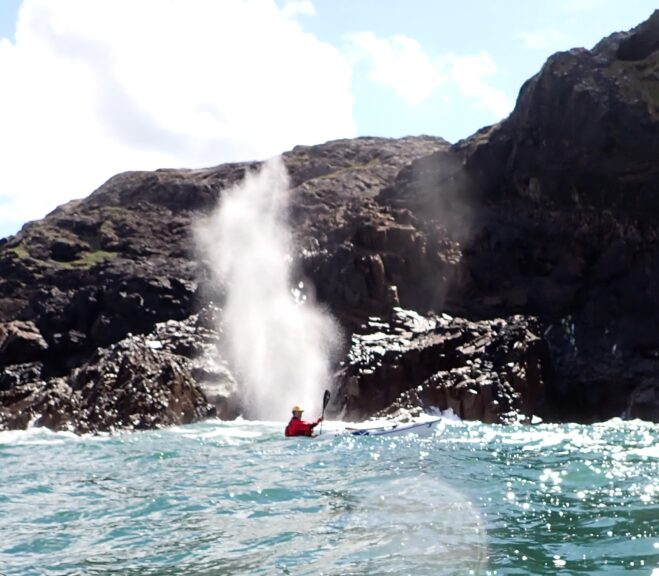
Spouting Cave living up to its name
Back on the mainland side of Iona, near the jetty where tour boats were disembarking passengers from the ship anchored offshore, lunch breaks were followed by an ice cream break. With the wind picking up, there was no time to visit the Abbey, the island’s main attraction. Instead, we headed back across the sound to our campsite, passing the Waverley, the world’s last surviving seagoing paddle steamer. Later, we learned it had just been used to ferry passengers back to Oban after the notoriously unreliable Caledonian MacBrayne ferry had broken down.
Iona Abbey
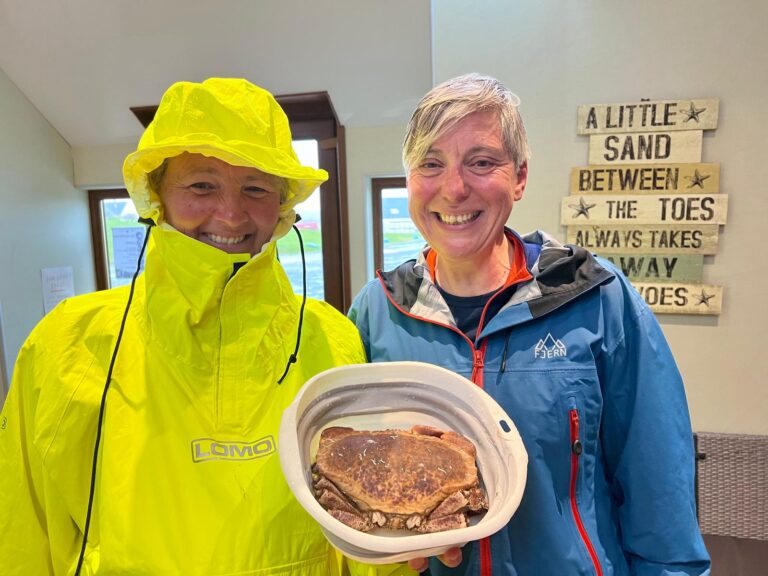
The next day on the water we had greater delights when Fiona bought a crab from a fisherman. She decided a spell in the campsite freezer was the humane way to despatch Claude (clawed— get it?). That was the easy part. She then had to persuade two American visitors there was nothing unusual to be seen in the freezer where they had left their food.
Claude
When Claude was judged sufficiently chilled, into the pot he went. Then it was over to Jude, who proved ruthlessly efficient at dismantling crabs. David and Liza had thoughtfully brought a large pop-up tent for use as a group shelter, and, wrapped in woolly hats, anoraks, and every last stitch of clothing, we all huddled beneath it and tucked into crabmeat.
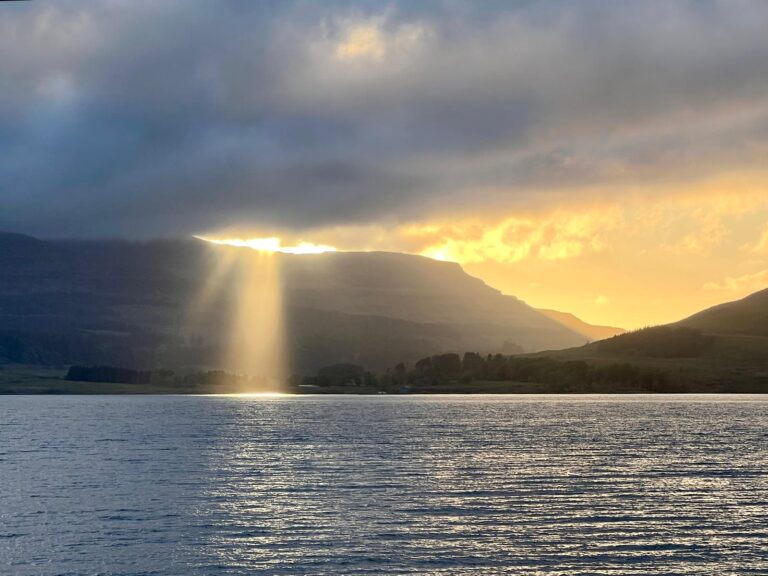
The spectre at the feast was the weather. We had rain by the bucketful; gales meant the group tent had to be twice taken down; the temperature dropped overnight to just five degrees sending Jude and Fiona for emergency purchases of locally woven blankets; and we all became weather junkies, glued to our weather apps.
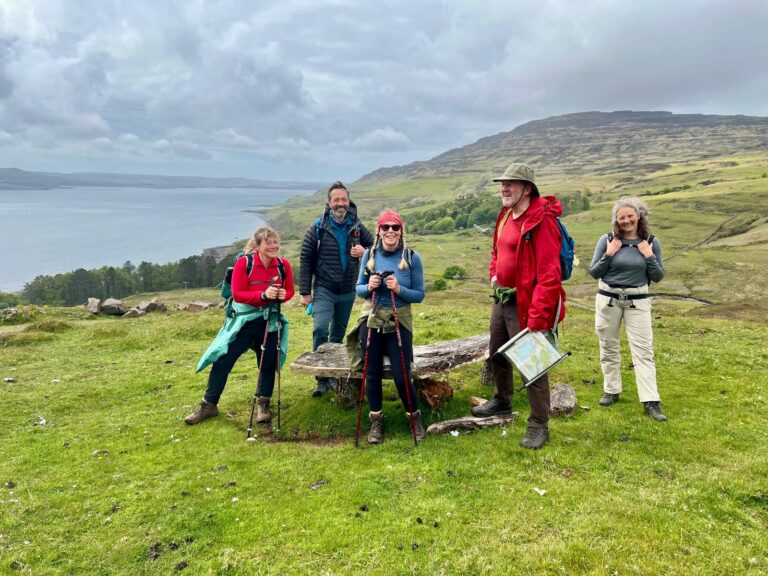
When the wind was too strong for kayaking, we put on hiking boots and headed for Burg, the massive headland across the sea loch. We didn’t even attempt the 1,400ft climb, but it was to be my toughest day. The plan was to follow the coast to a geological shrine: a 50-million-year-old fossilised tree, preserved in lava flows and first recorded over two centuries ago.
Walking around the Berg
The start was deceptively gentle – a forestry track leading through an avenue of contorted beech trees. But track turned into path, path became a rocky scramble, then we were faced with a climb down a shiny steel ladder bolted to the rock face. After that everyone had to pick their own way for the final half-mile along the boulder-strewn shore. That was when Gilly and I decided it was time to sit back and enjoy the sights while the others pressed on.
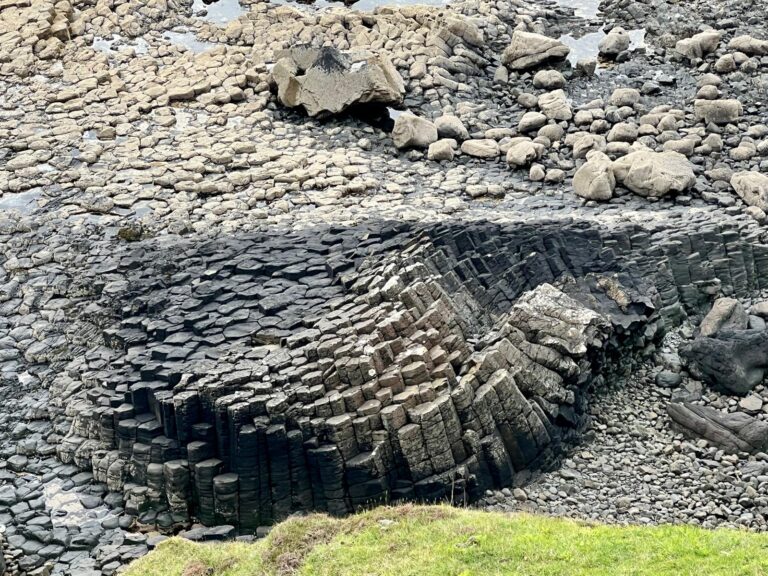
I’m glad we did. The basalt rock formations, which had been caused by violent eruptions, had settled into strange and wonderful shapes leaving a giant wheel that might have been a druids’ altar; sharply cut columns fit to grace a palace; and more columns fanning out like hands in prayer. They weren’t the only spectacles – I was delighted to see a pair of ravens patrolling the cliffs (and envious of Fiona, who claimed an eagle).
Basalt columns around the Berg
The next day was to be our last on the water, and we had the odd experience of admiring the entirety of our walk from a distance. There was nothing to make it look difficult. But then the same could have been said of that day’s paddling. A sheltered coast with hardly any tidal flow meant we could relax and we had time to admire the huge sea caves made by the waves to boom like giant orchestral instruments.
View of the Berg walking route the next daySouth side of Loch Scridain
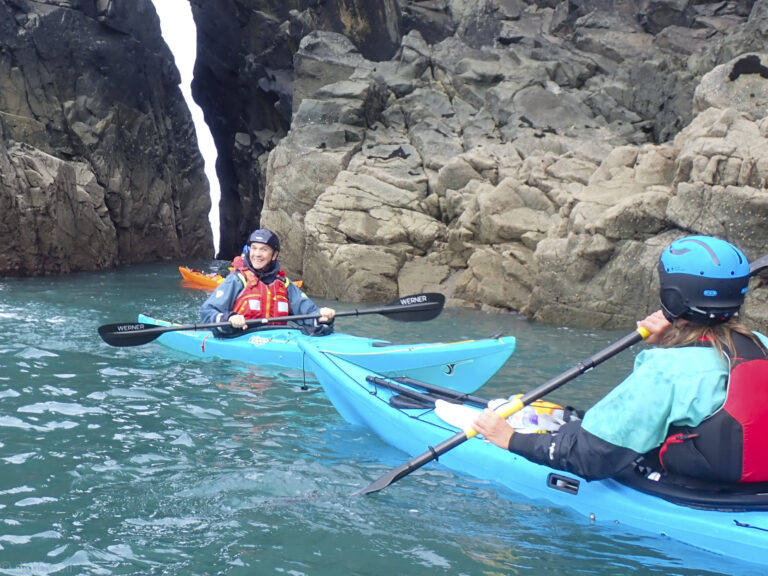
But the caves were a bit too tempting, and David was inspecting one interior when a sudden surge reduced his headroom from yards to just a couple of feet. There was no harm done, but the case for wearing a helmet could hardly have been made more forcefully.
Sod’s Law kicked in when it was time to strike tents and pack up – the rain stopped and the sun came out. Back on the mainland, the further south I drove the more layers I had to strip off. Now I’m writing this from a hot and sticky cauldron.
Give me the wild, wet, and windswept north any day.
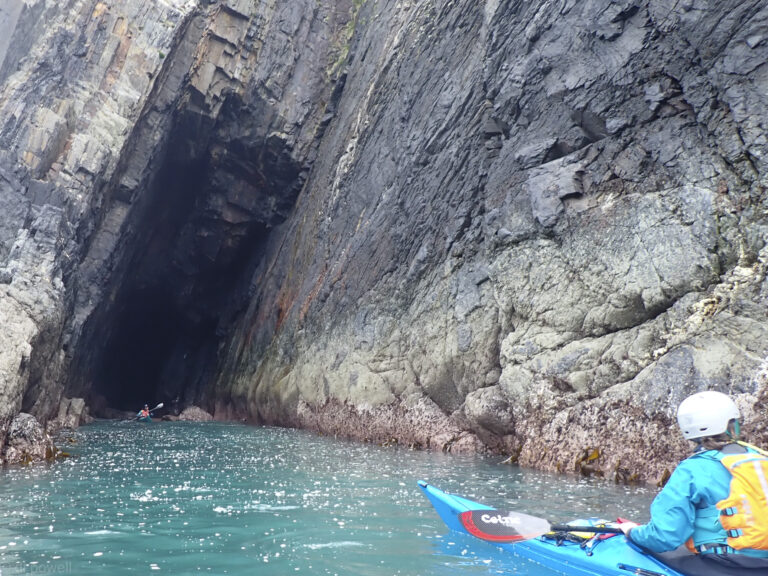
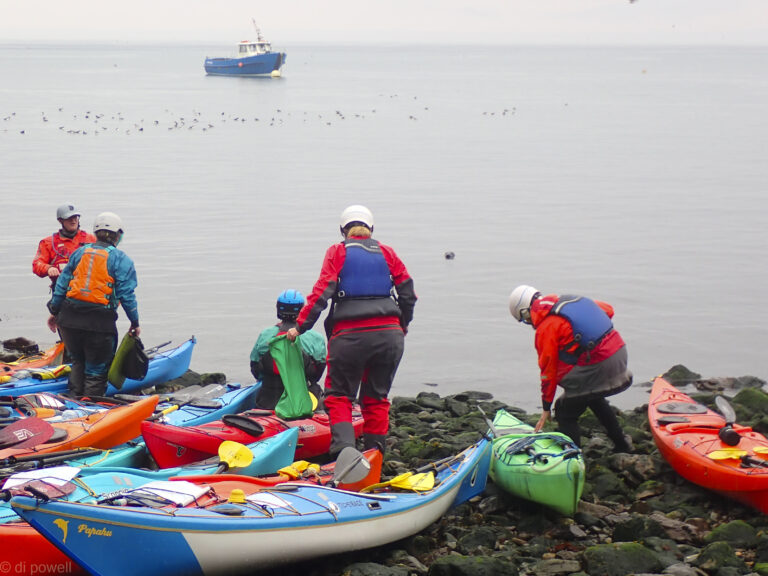
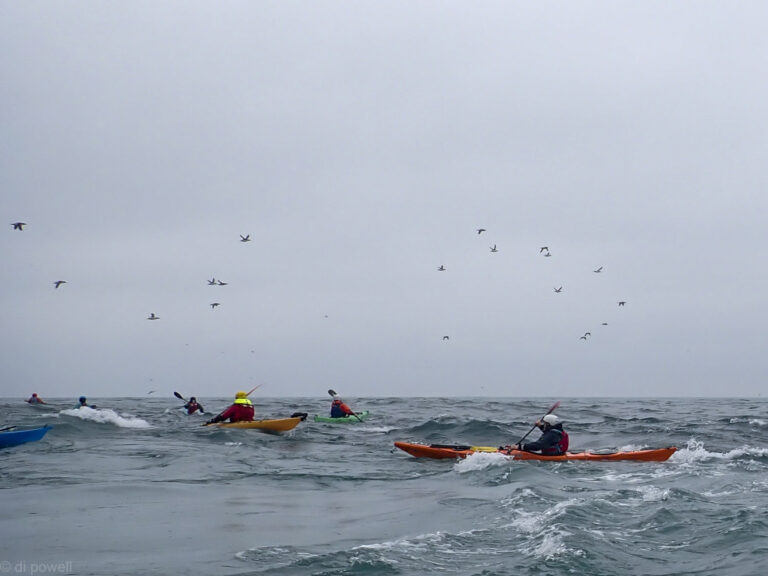
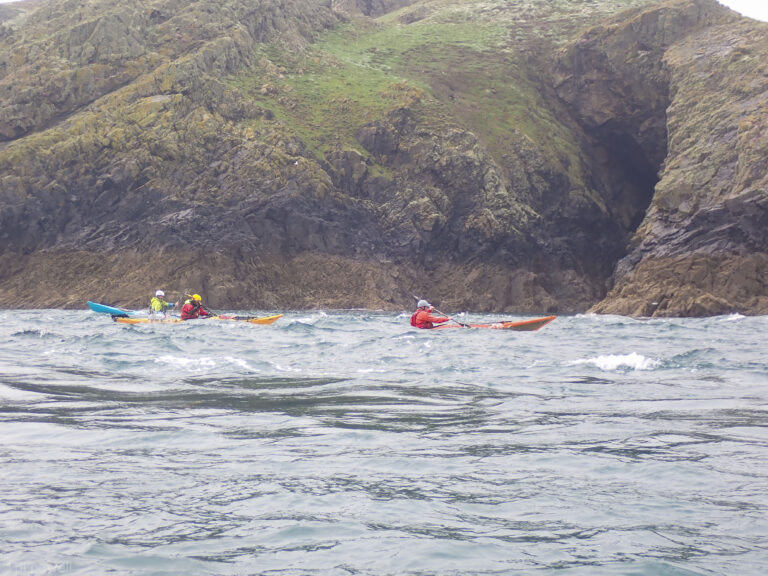
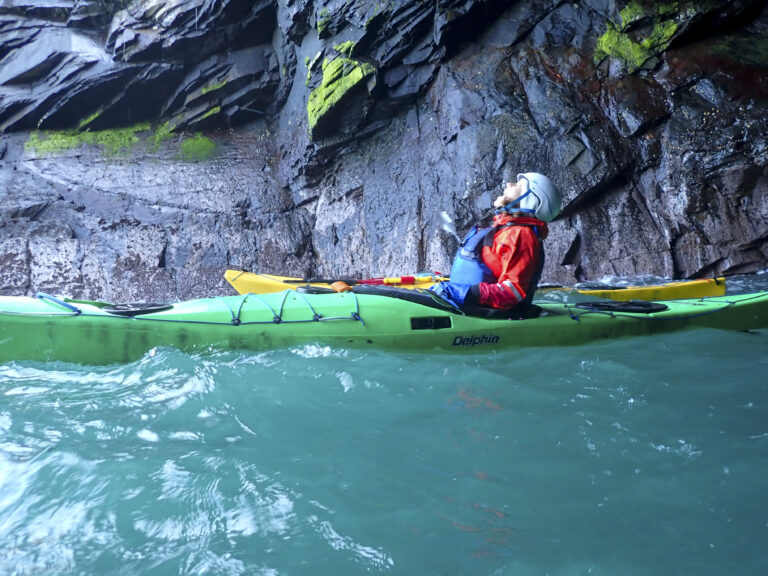
After settling in on Friday evening to our most comfortable accommodation at Preseli Venture, between St David’s and Fishguard, our fun-filled kayaking weekend started off meeting our coaches Martin, Ben and Rich from Sea Kayak Guides (SKG) at their new base at The Paddock, Mathry. There’s a small cafe and nice farm-shop there, and toilets. We agreed that with a south-westerly wind, we’d opt for a fairly gentle paddle day along the sheltered coastline from Porthgain Harbour, where there’s a slipway into the sea for easy launching. We headed west along the coast past Traeth Beach, Garn Lwyd and towards Trwyncastyell, then back via Cerrig Gwylan. Plenty of opportunities for some paddling through gullies, rock-hopping and exploring big and small caves. That evening we enjoyed a well-deserved dinner at the Sloop Inn at Porthgain.
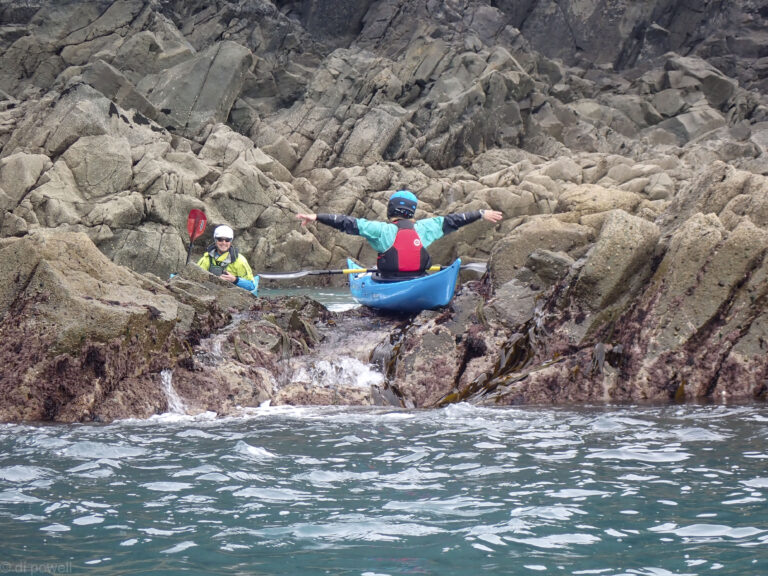
Successfully navigating a gully
Literally rock hopping!
Big cave
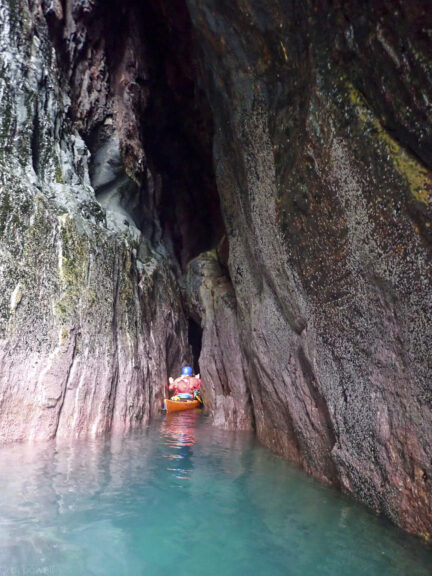
(Very) small cave
Looking for a bit more challenge on Sunday, we drove about an hour to Martins Haven, Marloes, where there’s a National Trust car park. It’s a bit of a walk to the beach from the car park so have trolleys – it’s possible to take a car down temporarily but space is tight. There are toilets (and an underwater photography gallery), and nearer the car park an NT shop selling lots of puffin paraphernalia and hot drinks. Leaving the harbour, carefully avoiding the Skomer Ferry and a number of scuba divers, we headed west past Wooltack Point and across to Skomer Island, much of which is a Nature Reserve. Stopping in at North Haven beach near the Warden’s house for lunch, and where an inquisitive seal kept an eye on us.
The seals kept an eye on us
Wildlife was abundant and we saw puffins, razorbills, guillemots and more. Continuing anti-clockwise round Skomer, there were some thrills or gritted teeth, depending on experience (!) in the fast flow turbulence on the north side, and the first elegant capsize.
Around Garland Stone
More fun in the fast flow of Little Sound on the south side, practising navigating the eddy lines and wave surfing – and another “swim”. Then finally past Midland Isle and across the often challenging Jack Sound, back to Martins Haven. Tired but happy, we ended the day with a hearty and delicious Indian meal back at the accommodation, accompanied by the most amazing sunset.
Little Sound tide race play
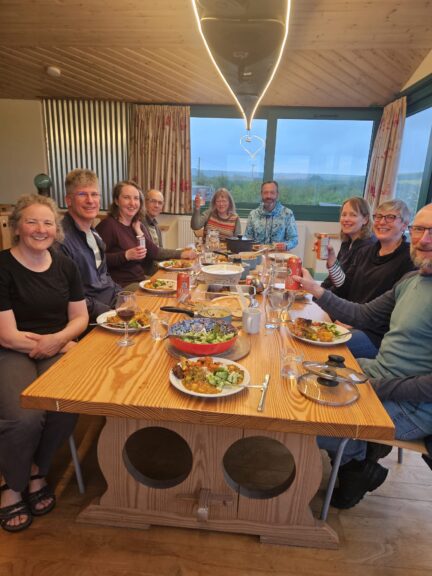
Dinner after a full day’s paddling around Skomer Island (and yes that is a kayak hanging from the roof!)
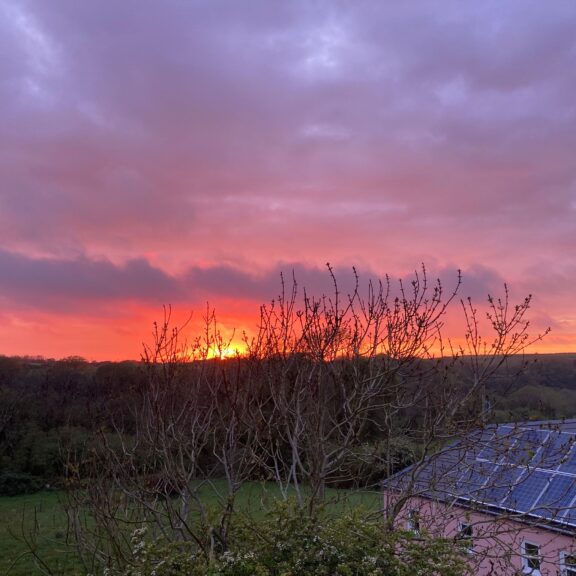
Sunset!
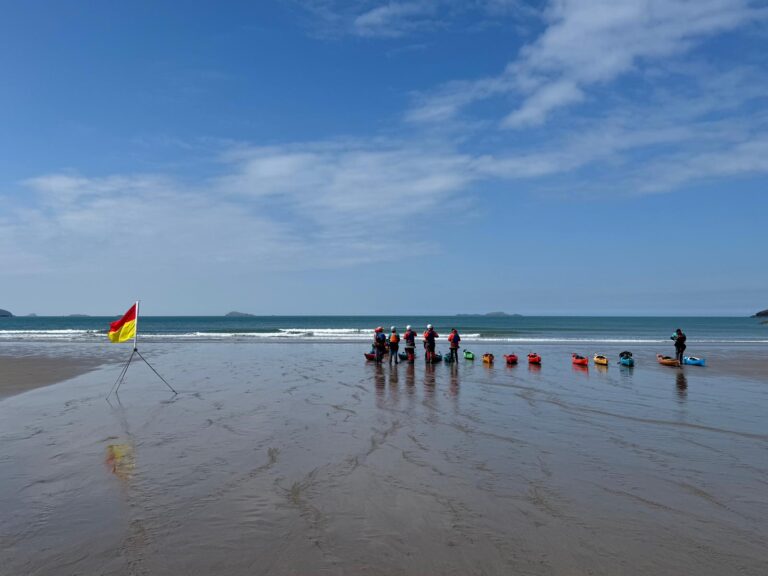
On Monday we started from Whitesands Bay on a linear route to Porthclais Harbour. It did mean moving most of the cars to Porthclais after dropping off the kayaks, but that didn’t take long. Whitesands Bay has a nice big beach, so easy for launching. There’s an RNLI lifeguard station there, and a good cafe/shop and toilets.
Whitesands Bay
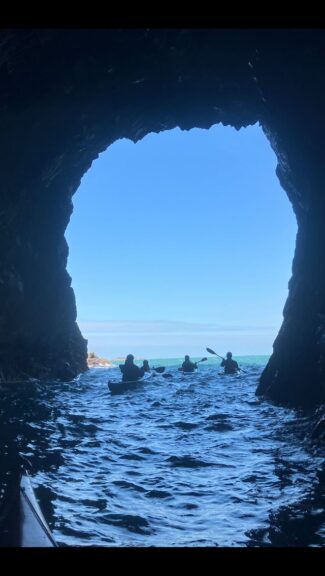
We headed slightly north away from the beach to St David’s Head, to optimise catching the wind and flow, before heading west over to Ramsay Island. We visited Ogof Hen (Old Cave), one of longest going back 200m. It was pretty awesome inside, and the roof of the cave drips freshwater.
Trying to drink water from Olaf Hen
Back out into the light
Ramsey Sound
We had lunch on the pebble beach below the abandoned farmhouse, then moved south down to The Bitches, playing around in the flow, crossing and re-crossing eddy lines – though the flow was more forgiving than in Little Sound.
Ramsey Harbour
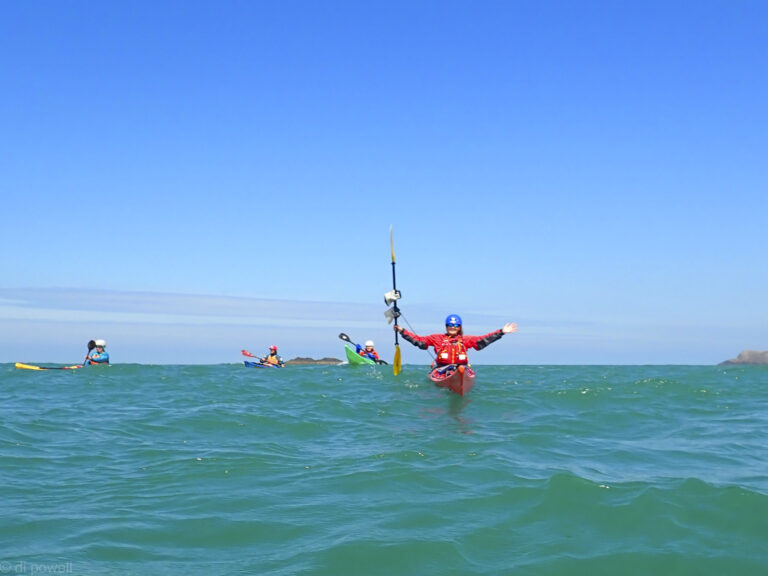
We crossed over Ramsey Sound doing a swift 7 knots (!), and then with the wind swinging east and touching Force 4, we had a bit of a push along the coastline to Porthclais Harbour (toilets and a closed kiosk). A few stayed behind for a bit practising rolls and rescues in the harbour. We returned to the happy news that CKC’s Liza had passed her Sea Kayak Leader assessment. Congratulations Liza! And many thanks to Andrew, Ingo, Jo and Jude for offering to be led over the two days (aka being ‘dunk monkeys’!).
Final night dinner
Thanks to Martin, Ben, Rich and Ollie from Sea Kayak Guides for an excellent weekend of coaching, learning and exploring!
You can see some of the highlights on our YouTube video of this weekend, here (7mins 40s): Pembrokeshire, May 2026.
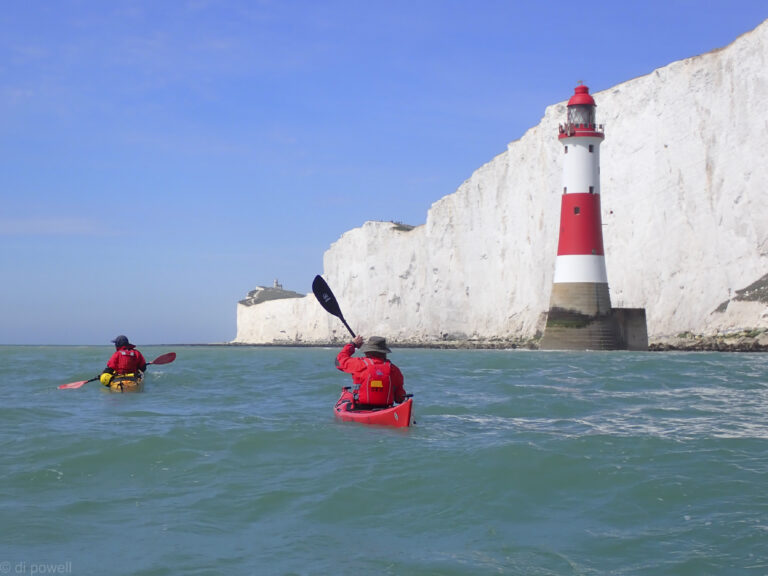
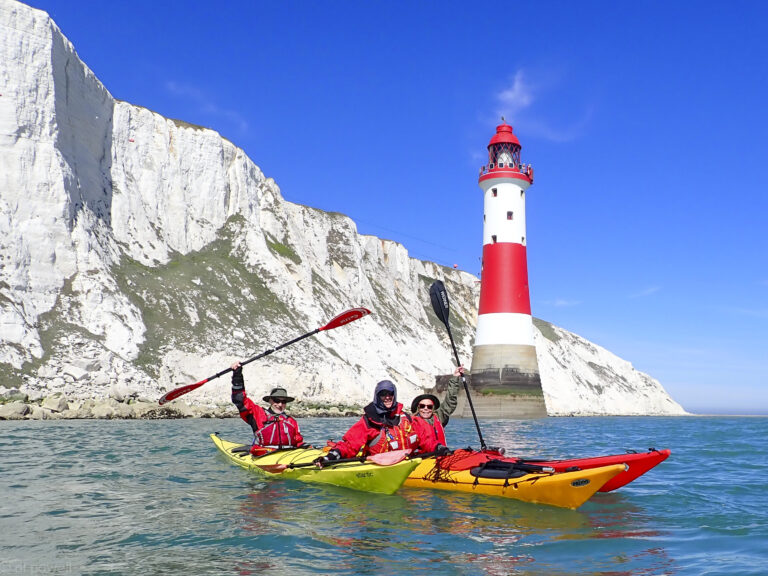
We haven’t been able to paddle to Beachy Head for the last 2 years as the weather and tides never worked for us. But this year we managed to get to see the lighthouse twice in 6 weeks!
Although the wind was a bit gusty while we were getting ready at Eastbourne, it was to get lighter throughout the day. Whereas on the previous trip we were dodging rain clouds, this time getting sunburnt was more of a concern.
Blue skies around Beachy Head
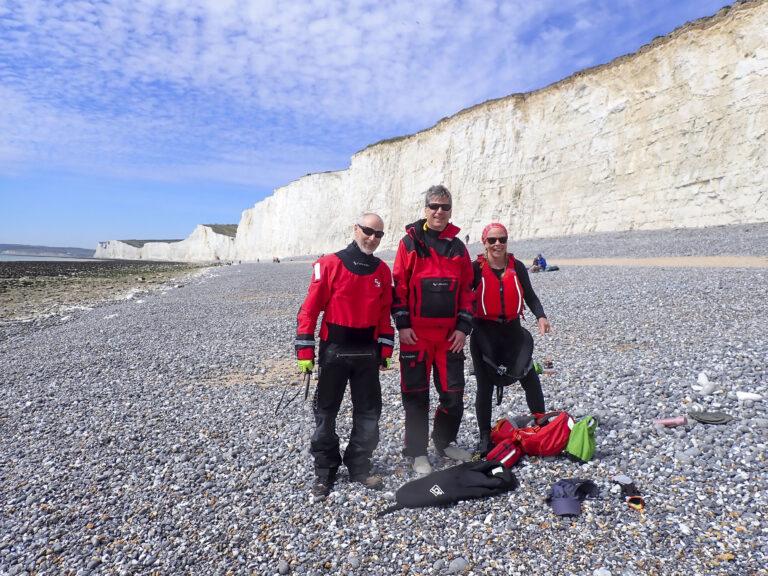
Paddling passed the lighthouse we were able to surf some small waves, pushing us on towards Birling Gap. Birling Gap had suffered a landslide of part of the cliff around the steps leading to the beach. We had hoped that we would have the beach to ourselves, but the steps had re-opened 2 days previously letting the general public back onto the beach. Still, it was quieter than usual. For lunch we kept well away from the cliff, just in case there was another rockfall.
Birling Gap
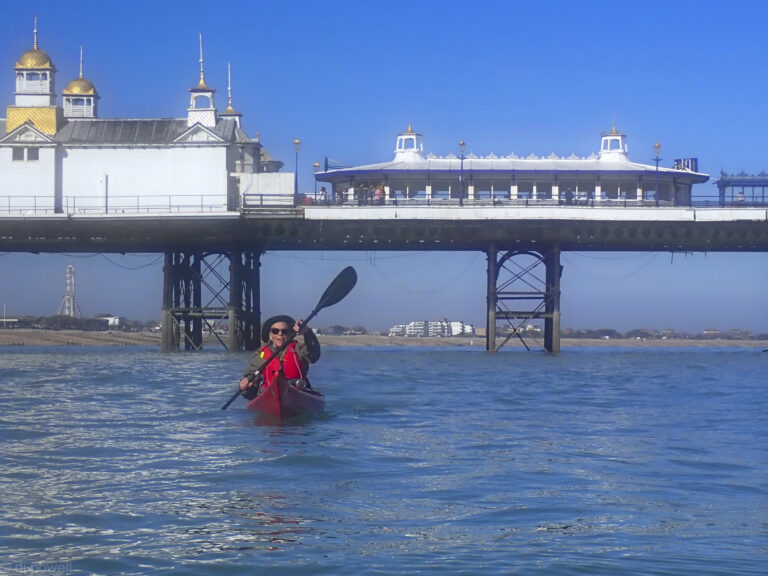
On the way we had seen one really big seal, but on the way back we saw a large group of 8. After paddling back to the launch point we continued onto have a look at the golden domes on the pier, before landing. An enjoyable day on the sea!