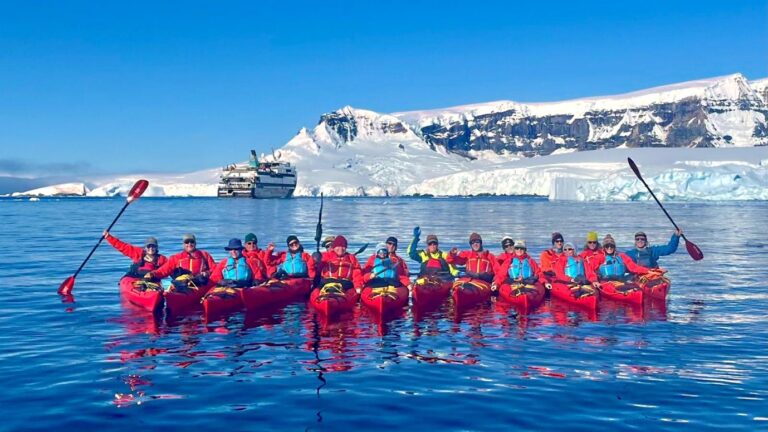
When I signed up to join an expedition cruise to Antarctica I ticked the box labelled ‘kayaking’. I had previously done what I thought was kayaking on the Loire in France and a single trip to look at Sea Otters in Monterey Bay. It turned out that this wasn’t nearly enough experience to qualify. I had about 9 months to pick up the skills. This was a little daunting for an older man based in central London – somewhat out of my comfort zone.
I started my education in the unlikely setting of a swimming pool – under the auspices of the Battersea Canoe Club in Clapham Leisure Centre. A good choice. The instructors were patient and calm and after six sessions I felt confident getting in and out of the boats and what to do if I turned over. But I realised there was quite a difference between the small water polo kayaks and full size sea kayaks – so I joined the Chelsea Kayak Club. My previous experience allowed me to gain my Discover award reasonably quickly (thank you David P.) and then consolidate by taking part in a few evening paddles up and down the river.
Kayaking in Antarctica is a step up again. The boats were double kayaks with a rudder operated by the rear paddler. They felt a little more stable than the single kayaks and it was good to have a ‘buddy’ in the boat with you. The kit was another matter. To stay warm you needed two thermal layers and a down jacket. You then had to worm your way into a dry suit (tight rubber gaskets around arms and neck), and fit a life jacket over the top. One felt like a Michelin Man. A neck gaiter and beanie hat would keep you protected from winds. Gloves I found were less necessary, the pogies being surprisingly effective at keeping your hands warm.
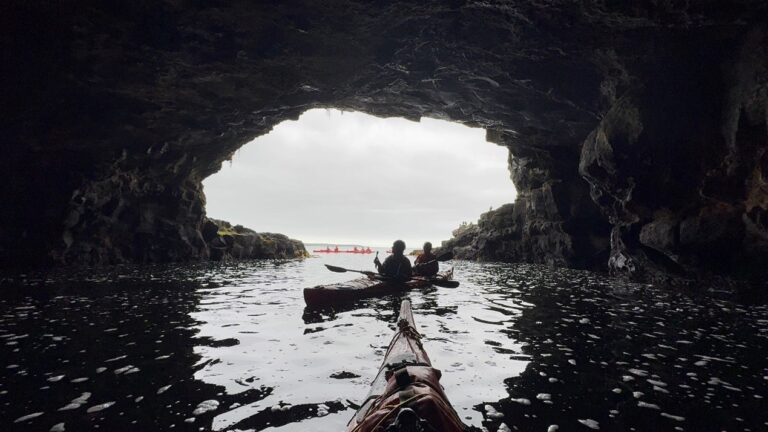
We were put through our paces at a sub – Antarctic island called Enderby Island. A gentle paddle around cliffs of basalt pillars with the odd cave. No ice, just a few fur seals for company.
We proceeded down to Antarctica proper with paddles at Cape Hallet and McMurdo Sound. Here we encountered ice in its many forms. Grease ice makes the sea soupy – like paddling through treacle. Brash ice – small, floating ice fragments that need careful navigation; bumping into a small block of ice can stop your kayak in its tracks. Nilas ice, where the ice has formed into thin sheets on the surface. Your kayak will just force them to slide over one another. And then Pancake ice, circular dishes of ice that you can hopefully force apart and find a way through.
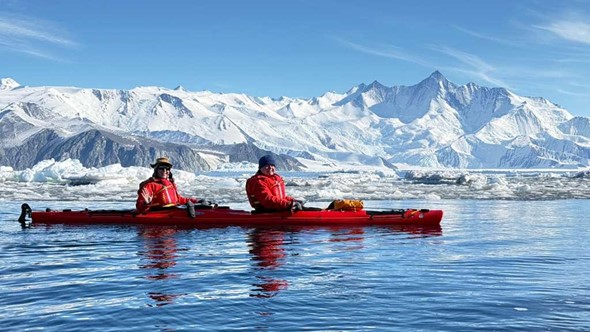
The paddle at Cape Hallet was extraordinary. Bright sunshine and the grease ice damped down any choppiness, just leaving a long wavelength swell where you would drop into an icy world in the troughs. The brash ice was all sparkly and the snow covered mountain scenery breathtaking.
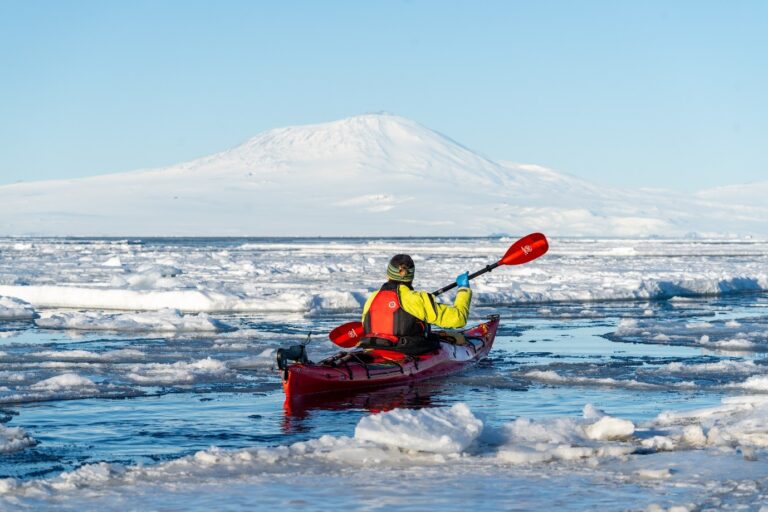
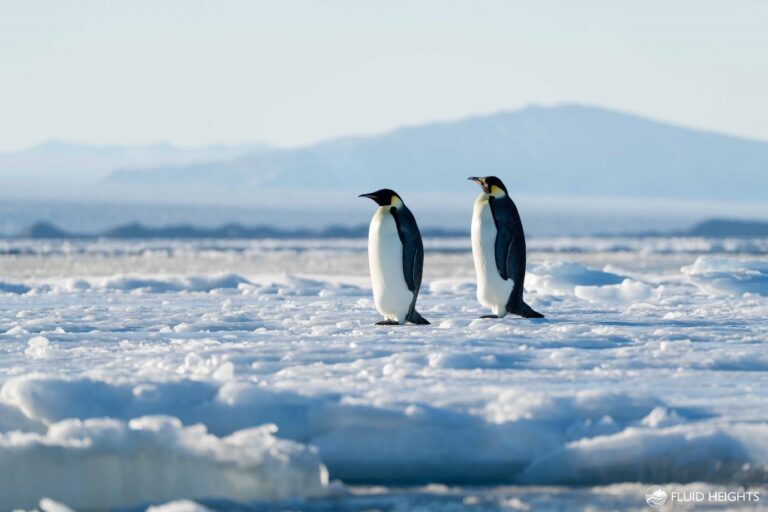
In the more southerly McMurdo the temperature was lower and the ice was much more intimidating. Large flat ice floes with narrow leads in between, all underneath the smoking volcano Mount Erebus. We did have a close encounter with some stately Emperor Penguins on the flat floes.
Our route then took us along the Ross Ice Shelf and beyond, to a part of the continent known as the peninsula. This is an offshoot of the main land mass and largely above the Antarctic Circle.
On a foggy morning we paddled around a Ukrainian base on the Argentine Islands. Visits to bases are no longer allowed (post covid) and so we had to forego the home distilled vodka that the Ukrainians normally serve to visitors. Rather oddly our only interaction with the scientists was one of them appearing from a sauna and promptly mooning at our flotilla! At one point we were asked to raft up as an inquisitive, three metre Leopard Seal buzzed around our kayaks. Just after being picked up in our Zodiac we witnessed its true nature in full tooth and claw – the seal caught a young Gentoo Penguin and hurled it back and forth in order to detach the feathers and skin from the body. Bloody and chilling, but fascinating.
Our final paddle was in the beautiful surroundings of Founier Bay on Anvers Island. The weather was perfect and the bay turned out to be full of Humpback Whales. They were actively feeding, so constantly sounding and returning to the surface with noisy blows – right in front of our kayaks. An afternoon that none of us wanted to stop.
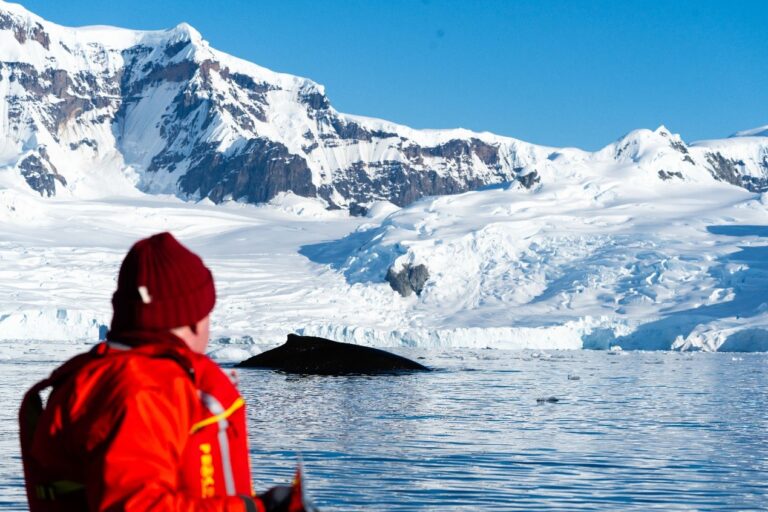
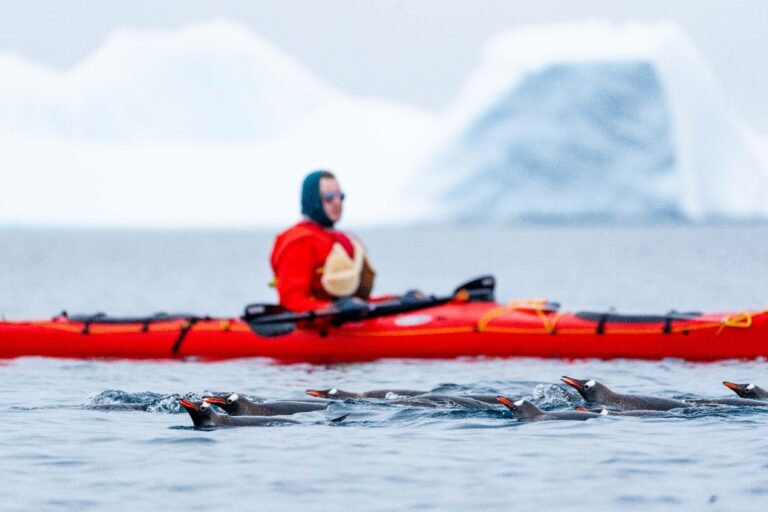
There are many wonderful things to experience in Antarctica – the scenery, the wildlife, the history (we visited both Shackleton’s Nimrod hut and Scott’s Terra Nova hut, still with their very British stores of Huntley and Palmer’s biscuits and Colman’s mustard!) – but the kayaking gave you a whole other perspective, sneaking up on sleeping seals, being visited by interested penguins and experiencing the full majesty of Cetaceans.
A wonderful and memorable trip for which I owe many thanks to the Chelsea Kayak Club. I would wholeheartedly encourage anybody thinking of going to Antarctica to tick that kayaking box!